
Most roundups of the best apps for self-improvement hand you a dozen interchangeable icons and no prices. This one groups them by the job you want done, quotes every price in dollars, and says plainly which ones stay free. Every price below was checked on July 28, 2026.
Short version: start with one app, not seven. Loop Habit Tracker and Medito cost nothing forever, with no ads and no account. Insight Timer gives away more than 300,000 guided meditations without charging a cent. Habitica suits people who like games. YNAB is the only subscription here I would call worth $109 a year.
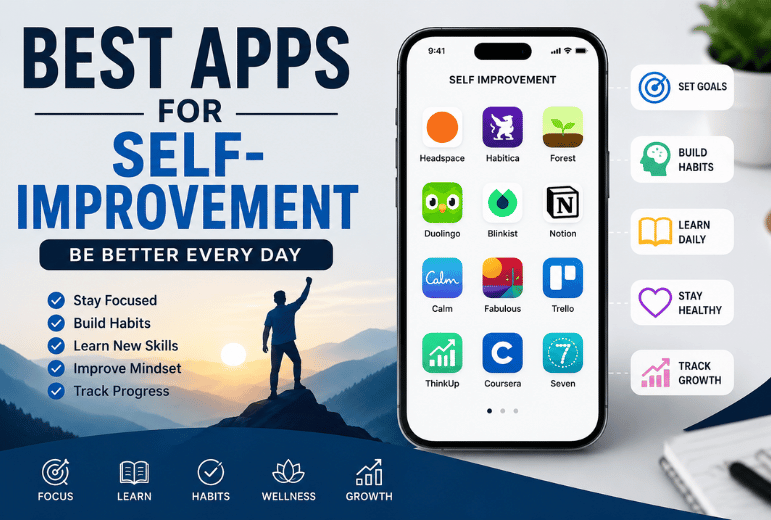
The 14 Picks At a Glance
| Job to be done | App | Platforms | US price | Usable for free? |
| Habits | Loop Habit Tracker | Android | Free, open source | Yes, all of it |
| Habits | Streaks | iOS, Apple Watch | $5.99 once, no subscription | No free version |
| Habits | Habitica | iOS, Android, web | Free: $4.99/mo or $47.99/yr | Yes, the core game |
| Focus | Forest | iOS, Android | Free: $5.99/mo or about $35.99/yr | Partly, with nudges |
| Meditation | Medito | iOS, Android | Free, nonprofit, no ads | Yes, all of it |
| Meditation | Insight Timer | iOS, Android, web | Free; plus $9.99/mo or $59.99/yr | Yes, a huge free library. |
| Meditation | Headspace | iOS, Android, web | $12.99/mo or $69.99/yr | No trial available |
| Sleep | Calm | iOS, Android, web | $14.99/mo or $69.99/yr | No trial |
| Learning | Duolingo | iOS, Android, web | Free with ads; Super $12.99/mo or $83.99/yr | Yes |
| Learning | Anki | Desktop, Android, iOS | Free; $24.99 once on iPhone | Yes, except iPhone |
| Fitness | Nike Run Club | iOS, Android | Free | Yes |
| Fitness | Strava | iOS, Android, web | Free: $11.99/mo or $79.99/yr | Partly |
| Money | YNAB | iOS, Android, web | $14.99/mo or $109/yr, 34-day trial | No |
| Journaling | Day One | iOS, Android, Mac | Free; Silver: $8.99/mo or $49.99/yr | Yes, unlimited entries |
Key Takeaways
- Four of these cost nothing, ever: Loop Habit Tracker, Medito, Nike Run Club, and the desktop version of Anki. No ads, no upsell, no trial clock.
- Meditation subscriptions cluster near $70 a year. Insight Timer and Medito make that price hard to justify unless you want a specific teacher.
- Habit and mood apps collect sensitive personal data. Check what leaves your phone before you type anything private into one.
- Retention across this category is low, and downloads are the easier part.
- None of these apps treat anything. If you are struggling, please talk to a doctor or a therapist.
How I Picked, and What “Free” Means Here

I only kept apps I could price from an official source: the US App Store listing, the Play Store, or the company’s own pricing page. Anything I could not verify got cut. Best Apps for Self-Improvement: That rule alone removed several names you will see on page one.
“Free” also gets used loosely. A seven-day trial is not free. Neither is a habit tracker that caps you at three habits until you pay. I judged free tiers the same way we judge free antivirus software picks: does the free version do the actual job, or is it a demo wearing a costume?
Habits and Focus: The Streak Apps
Habit trackers are where most people start. They are also where the free options are strongest. Loop Habit Tracker is my pick if you use Android. The app is open source, carries no ads, needs no account, and sells nothing inside. Its Play Store data safety entry says it collects nothing. Your habit history sits on your phone and nowhere else. The tradeoff: Android only, and the design is plain.
Streaks costs $5.99 once on iPhone and never asks again, which in 2026 feels almost radical. You get twelve habit slots, Apple Health syncing, and a watch face that looks good. There is no free tier, so you are buying blind.
Habitica turns your to-do list into a role-playing game with a party, quests, and a health bar. The core is free. A subscription runs $4.99 a month or $47.99 a year and mostly buys cosmetics and gems. If the game does not grab you in a week, nothing later will.
Forest plants a virtual tree while you keep off your phone and kills it if you leave. Installing is free, with a subscription at $5.99 a month or roughly $35.99 a year. It works on guilt, which some people find effective, and others find grating.
One practical note before you install any of these. Habit apps ask for notifications, activity data, and sometimes location, so it is worth knowing your Google Play Store settings and how to revoke a permission after the fact.
Meditation and Sleep, Without the Overclaiming
This is where the money is, and this is where marketing often gets loose. Medito is free. Not freemium, not trial-based. It is built by the Medito Foundation, a registered Dutch nonprofit; it needs no account, carries no ads, and its code is public. Hundreds of guided sessions, courses, and sleep tracks, at no cost, forever.
Insight Timer gives away an enormous library, including its timer and live sessions. Member Plus adds courses and offline downloads for $9.99 a month or $59.99 a year. Most people never need it.
Headspace ($12.99 a month, $69.99 a year) and Calm ($14.99 a month, $69.99 a year) are the polished, celebrity-narrated options. Both are genuinely well made. Both are also closed behind a paywall after a short trial, and neither does anything Medito cannot do for nothing.
Here is the part the app stores will not tell you. A meditation app can help you build a calming routine. It is not therapy; it does not treat anxiety or depression, and no app should be your only plan if you are having a hard time. Talk to a professional. A streak counter is not a substitute for one.
Learning, Fitness, and Money

Duolingo remains the easiest way to start a language. The free version, with ads and heart limits, teaches the same lessons; Super removes the friction for $12.99 a month or $83.99 a year.
Anki is the serious choice for memorizing anything, from anatomy to vocabulary. Desktop and Android are free. The iPhone version costs $24.99 once, and that purchase funds the rest.
For movement, Nike Run Club is free with guided runs and training plans. Strava keeps a usable free tier for logging activity, then charges $11.99 a month or $79.99 a year for segment leaderboards and route planning.
Money is the category where free options are weakest. YNAB costs $14.99 a month or $109 a year after a 34-day trial, and college students can get a year free with proof of enrollment. That is expensive. It is also the only app here that makes you assign every dollar a job, which is the part that changes behavior. If you want zero cost, your bank’s own app plus a spreadsheet does most of it.
Day One covers journaling: unlimited entries free, with Silver at $8.99 a month or $49.99 a year for unlimited photos and audio. If free tools interest you, our roundup of free video editing software shows how much a no-cost app can do.
What These Apps Do With Your Data

Mood logs, sleep records, run routes, and journal entries are some of the most personal data you will ever type into a phone. Very few roundups mention this. They should.
Calm’s App Store privacy label says purchases, identifiers, and usage data may be used to track you across other companies’ apps and websites. Identifiers and usage data also get linked to you for third-party advertising. Strava’s label lists precise location and health and fitness data as linked to your identity. Neither is unusual for the category. Neither shows up on the download button.
Compare that with Loop Habit Tracker, which collects nothing, or Medito, which does not even ask for an account. If a mood tracker is going to hold a record of your worst weeks, offline and open-source is worth more than a prettier chart.
Two habits protect you here. Read the privacy label on the store page before you install, and check independent coverage on trusted tech review sites rather than the app’s own blog.
Most People Quit Within a Month, and That Is the Real Problem.
Here is the number that should shape how you choose.
A 2019 analysis in the Journal of Medical Internet Research screened 386 mental health and wellbeing apps and studied 93 of them in depth. The median 30-day retention rate was 3.3%. Out of every hundred people who install one of these apps, roughly three still open it a month later.
That figure is not an argument against trying. It is an argument against paying for twelve months upfront and against thinking the choice of app is the hard part. It never is. The hard part is the fifteenth morning, when the novelty has gone, and the reminder feels like nagging.
So pick the smallest thing that could work. One app. One habit. Free, if a free version does the job, because a subscription you cancel in week three costs you money and teaches you nothing.
The Best Apps for Self-Improvement, by Who You Are

If you want to spend nothing: Loop Habit Tracker on Android, Medito for meditation, and Nike Run Club for movement. That set is complete and permanent and collects almost no data about you.
If you are on an iPhone and want one purchase: Streaks at $5.99, paired with Medito. Under six dollars, no recurring charge. If motivation is the problem, use Habitica for free, plus Forest when you need to stay off the phone.
If one paid app is worth it: YNAB. Budgeting is the job where the paid tool clearly beats the free one, and the 34-day trial is long enough to know. My overall recommendation for most readers: install Medito and one free habit tracker today, use both for three weeks, and only then decide whether anything deserves a card number.
Conclusion
The best apps for self-improvement are the ones you will actually keep using, not the ones with the longest feature list or the biggest marketing budget. Whether your goal is building better habits, improving focus, learning a new skill, managing money, or reducing stress, starting with one well-chosen app is far more effective than downloading several at once.
Free options like Loop Habit Tracker, Medito, and Nike Run Club offer outstanding value. At the same time, paid services such as YNAB are worth considering only if they solve a specific problem you consistently face. Before committing to any app, check its pricing, privacy practices, and free-tier limitations. Remember that no app can replace personal effort, professional medical care, or long-term consistency.
FAQ
There is no single winner, because the apps do different jobs. For a first install, Medito for meditation and Loop Habit Tracker for habits cover the most ground for nothing. Among the best apps for self-improvement that charge money, YNAB gives the clearest return.
Some genuinely are. Loop Habit Tracker, Medito, Nike Run Club, and desktop Anki has no ads, no paywall, and no expiry. Others use “free” to mean a trial or a crippled tier, so check before you commit.
They work when you keep using them, which most people do not. The JMIR retention figure above shows how steep the drop-off is. An app can make a habit easier to remember; it cannot supply the reason you wanted the habit.
Meditation subscriptions sit around $60 to $70 a year, with Headspace at $69.99 and Insight Timer Plus at $59.99. Habit apps are cheaper: Habitica is $47.99 a year, Streaks is a one-time $5.99, and several good trackers cost nothing.
The answer varies enormously. Some store everything on your device and collect nothing. Others link usage data, identifiers, and location to your account and share it with advertising partners. The App Store or Play Store privacy label is the fastest way to check.
No. These apps are well-being tools, not treatment, and none of them is a substitute for professional support. If low mood, anxiety, or sleep problems are affecting your daily life, speak to a doctor or a licensed therapist.