


You don’t need one marketplace for every product you sell. The right platform depends on your inventory, profit margins, shipping preferences, and the buyers you want to reach.
The best eBay alternative depends on what you sell. Mercari is a strong all-around option for casual sellers who ship products. Facebook Marketplace and OfferUp work well for local sales. Depop and Poshmark suit fashion, Etsy serves handmade and vintage sellers, Whatnot focuses on collectibles, and Bonanza offers a broad marketplace for general merchandise.
Quick Comparison of the Best Selling Platforms
| Platform | Best for | Current cost pattern | Main tradeoff |
| Facebook Marketplace | Local furniture, electronics, and household goods | Local transaction costs depend on how the buyer and seller arrange payment | Less suitable for sellers who need a consistent nationwide shipping workflow |
| Mercari | General used goods and casual sellers | 10% seller fee | Buyers also pay a protection fee |
| Depop | Fashion, vintage clothing, and trend-driven items | U.S. sellers pay no standard selling fee; payment processing applies | Audience is more fashion-focused |
| Poshmark | Clothing, shoes, and accessories | $2.95 on sales under $15; 20% on sales of $15 or more | High commission on larger sales |
| Etsy | Handmade, creative, customized, and vintage goods | $0.20 listing fee plus a 6.5% transaction fee and payment processing | Poor fit for ordinary mass-market resale |
| Whatnot | Collectibles and live selling | Standard U.S. rate is an 8% commission plus payment processing for most categories | Live selling requires more seller involvement |
| OfferUp | Local pickup and bulky items | Local selling only; nationwide shipping has ended | No longer a nationwide shipping marketplace |
| Bonanza | Broad catalogs and sellers moving existing listings | Free listings; final value fees start at 3.5% | Smaller marketplace audience than major platforms |
Fees and policies above were checked against current platform information in July 2026. Rates may vary by country, category, advertising choice, taxes, or optional services. Mercari currently charges sellers a 10% fee, while buyers pay a separate Buyer Protection fee.
Sellers in the U.S., U.K., and Australia currently pay no standard Depop selling fee. U.S. Depop Payments transactions carry a processing fee of 3.3% plus $0.45. Poshmark charges $2.95 on sales below $15 and 20% on sales of $15 or more. Etsy charges $0.20 per listing and a 6.5% transaction fee, with payment processing charged separately.
Whatnot’s standard U.S. commission for most categories is 8%, plus a payment processing fee. Some categories and promotional programs may use different rates.
TL;DR: Start with Mercari if you sell a mix of easy-to-ship used products. Use Facebook Marketplace or OfferUp when local pickup makes more sense. Fashion sellers should compare Depop with Poshmark. Whatnot stands out for collectibles, while Etsy works best for sellers whose products fit its specialized audience.
The 8 Best Sites Like eBay for Sellers in 2026

1. Mercari: Best All-Around Choice for Casual Sellers
Mercari is one of the closest alternatives for sellers who want to photograph an item, set a price, ship it, and move on. Its broad range of categories works well for electronics, toys, home goods, clothing, games, and everyday secondhand items.
The current seller fee is 10% under Mercari’s current fee structure. Buyers also pay a separate protection fee.
Pros:
- Simple listing process
- Broad product coverage
- Nationwide shipping
- Predictable seller fee structure
Cons:
- Buyer-side fees may increase the total price shoppers see
- The effect can be more noticeable on higher-priced items
For sellers who rely heavily on mobile tools, Techixia’s app reviews and guides can help when comparing the apps used throughout an online-selling workflow.
2. Facebook Marketplace: Best for Local Reach
Facebook Marketplace makes the most sense when shipping would reduce your margin or create unnecessary work. It is particularly useful for furniture, exercise equipment, appliances, televisions, tools, and other bulky goods.
Its biggest advantage is its ability to connect sellers with local buyers. You can put an item in front of people already searching in their area instead of packing a large product for nationwide delivery.
Pros:
- Strong local reach
- Broad product categories
- Direct communication with buyers
- No need to build a separate storefront
Cons:
- Seller experience can vary by location
- Local transactions require more coordination with individual buyers
Use Facebook Marketplace primarily as a local sales channel rather than assuming it can replace a structured nationwide marketplace for every type of product.
3. Depop: Best for Trend-Driven Fashion
Depop makes sense when presentation and style matter almost as much as the product itself. It is especially well suited to clothing, vintage fashion, streetwear, accessories, and products that appeal to style-conscious shoppers.
Sellers in the U.S., U.K., and Australia currently pay no standard Depop selling fee. U.S. Depop Payments transactions carry a processing fee of 3.3% plus $0.45. Boosted listings may add separate charges.
Pros:
- Low standard seller costs for U.S. sellers
- Audience focused on fashion and personal style
- Strong fit for vintage and trend-driven inventory
Cons:
- Less suitable for tools, computer parts, furniture, and mixed household inventory
- Sellers outside the fashion niche may find broader marketplaces more useful
4. Poshmark: Best for a Simple Fashion Resale Workflow
Poshmark is another fashion-focused option, but its fee structure differs significantly from Depop.
Listing is free. The current U.S. fee is $2.95 on sales below $15 and 20% on sales of $15 or more. That means a $100 sale generates a $20 platform fee before other seller costs are considered.
Pros:
- Fashion-focused buyer base
- Established resale workflow
- Straightforward seller earnings calculations
Cons:
- A 20% fee can make lower-margin inventory less attractive
- Higher-priced items may produce significant platform fees
Compare your expected net earnings rather than choosing between fashion marketplaces based on audience size alone.
5. Etsy: Best for Handmade, Creative, and Vintage Inventory
Etsy solves a different problem from a general resale marketplace. It works best when the product matches what shoppers are already looking for: creative, distinctive, handmade, personalized, or vintage items.
Etsy currently charges $0.20 to create or renew a listing and a 6.5% transaction fee. Payment processing varies according to the location of the seller’s bank account. Advertising and other optional services may create additional charges.
Pros:
- Focused buyer intent
- Strong fit for creative and distinctive products
- Established marketplace for handmade and vintage inventory
Cons:
- Ordinary consumer goods may perform better elsewhere
- Multiple fee types can affect overall margins
If your products do not have a handmade, creative, customized, or vintage angle, another marketplace will probably be a better fit.
6. Whatnot: Best for Collectibles and Live Selling
Whatnot deserves attention from sellers of trading cards, comics, toys, memorabilia, coins, and other products with active collector communities.
For most U.S. categories, Whatnot currently charges an 8% commission on the final sale price, along with payment processing fees. Selected categories and programs may qualify for different rates.
Pros:
- Strong fit for enthusiast products
- Built around collector communities
- Supports live selling and auctions
- Potential to build a repeat audience
Cons:
- The live-selling model requires more active participation
- Sellers who prefer passive fixed-price listings may find other platforms easier to manage
Whatnot makes the most sense when your inventory benefits from interaction, excitement, demonstrations, or live bidding.
7. OfferUp: Best for Local Pickup
OfferUp belongs in a 2026 comparison, but older marketplace guides may give sellers an outdated impression of its shipping options.
OfferUp ended nationwide shipping for new listings on September 23, 2025. Shipping was then removed from previously eligible listings in October 2025. The company’s current focus is local buying and selling through in-person meetups.
That makes OfferUp useful for furniture, home goods, tools, bicycles, appliances, and products you would rather hand directly to a buyer than box and ship.
Pros:
- Clear local-selling focus
- Mobile-friendly listing process
- Useful for bulky or difficult-to-ship products
Cons:
- No longer supports nationwide marketplace shipping
- Local transactions require coordination between buyers and sellers
OfferUp should now be treated as a local-only marketplace rather than a nationwide shipping alternative.
8. Bonanza: Best for Broad Catalog Sellers Who Want Lower Base Fees
Bonanza is worth testing if you want a conventional marketplace without switching to a niche-specific selling model.
Listings are free and do not expire, while final value fees start at 3.5%. Bonanza also supports importing products from marketplaces such as eBay, Amazon, and Etsy, which can reduce setup work for sellers with existing catalogs.
Pros:
- No standard listing fee
- Relatively low starting final value fee
- Catalog-import features for established sellers
- Broad product coverage
Cons:
- Smaller audience than major marketplaces
- Lower fees matter only if the marketplace generates enough qualified buyers
For that reason, Bonanza may work better as an additional sales channel than as an immediate full replacement.
What a $100 Sale Can Look Like
Fees are easier to understand when expressed in dollars rather than percentages. The example below assumes a $100 sale amount and excludes shipping, taxes, advertising, subscriptions, and special category rates.
| Platform | Simplified seller charge | Approximate amount left |
| eBay, most standard categories | 13.6% + $0.40 | $86.00 |
| Mercari | 10% | $90.00 |
| Depop, U.S. standard payment processing | 3.3% + $0.45 | $96.25 |
| Poshmark | 20% | $80.00 |
| Whatnot, standard category | 8% commission plus processing | Varies with order value |
This is a simplified comparison, not a payout quote. Each marketplace calculates fees differently, and some include shipping, taxes, processing, or other charges in the amount used to determine seller fees.
For example, eBay calculates its final value fee based on the total amount of the sale under its applicable fee rules. Most standard categories currently use a percentage-based final value fee, along with a per-order charge.
The table shows why the marketplace with the lowest fees is not automatically the best choice. A platform that costs $5 more per sale may still be more profitable if it attracts stronger demand and sells your inventory faster, much like choosing the right device from the Galaxy Z Fold4 to Buy in 2026 guide instead of focusing solely on the lowest price.
How to Choose an eBay Alternative Without Losing Reach
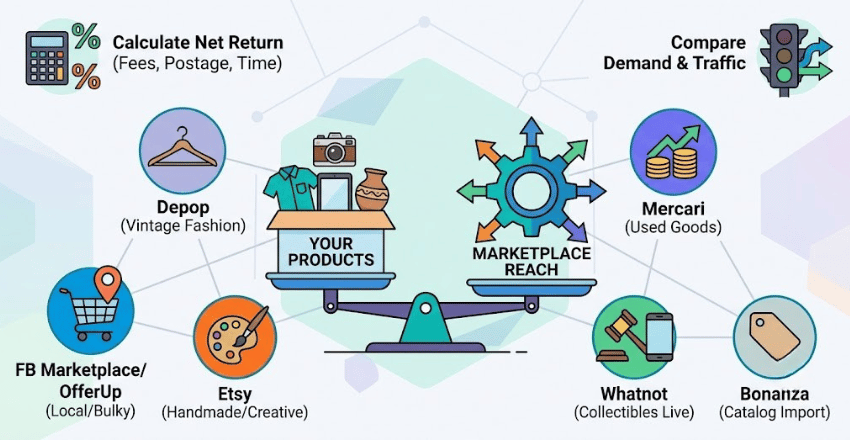
Start with your product, not the marketplace.
| If you mainly sell… | Start with… | Why |
| Mixed-use goods that can be shipped | Mercari | Broad categories and simple nationwide resale |
| Furniture or bulky household items | Facebook Marketplace or OfferUp | Local pickup removes packing and shipping |
| Trendy or vintage fashion | Depop | Fashion-focused audience and low standard U.S. seller fees |
| Mainstream clothing and accessories | Poshmark | Dedicated fashion resale workflow |
| Handmade or distinctive creative products | Etsy | Specialized buyer intent |
| Collectibles | Whatnot | Collector audience and live-selling format |
| Large existing catalog | Bonanza | Free listings and catalog-import tools |
Next, calculate your likely net return on a typical item. Include marketplace fees, payment processing, postage, packaging, advertising, returns, and the value of your time.
Then compare demand. Saving five percentage points in seller fees means little if your products receive almost no qualified traffic.
If you sell consumer electronics, product knowledge can also affect pricing. Techixia’s guide to trusted tech review sites can help you compare sources when evaluating a device’s features and market position.
For many established sellers, cross-listing is a better strategy than switching platforms overnight. Keep the channels that already generate sales and then test one new marketplace with a controlled group of products.
Track the results before expanding.
What eBay Still Does Better
A replacement only makes sense if it improves the parts of selling that matter most to you.
eBay still combines fixed-price listings, auctions, broad category coverage, seller tools, and access to a large marketplace in one system. U.S. sellers without a Store also receive a monthly allowance of zero-insertion-fee listings before standard insertion charges apply.
The disadvantage is that selling costs can become substantial in some categories. Fees may also vary according to category, listing options, seller performance, and other factors.
That creates the main tradeoff. A smaller marketplace may charge less or attract a more focused audience, while a larger platform may provide broader exposure.
Don’t ask only which site is cheapest. Ask which marketplace produces the highest net profit per item and per hour of work.
Should You Use One Marketplace or Several?
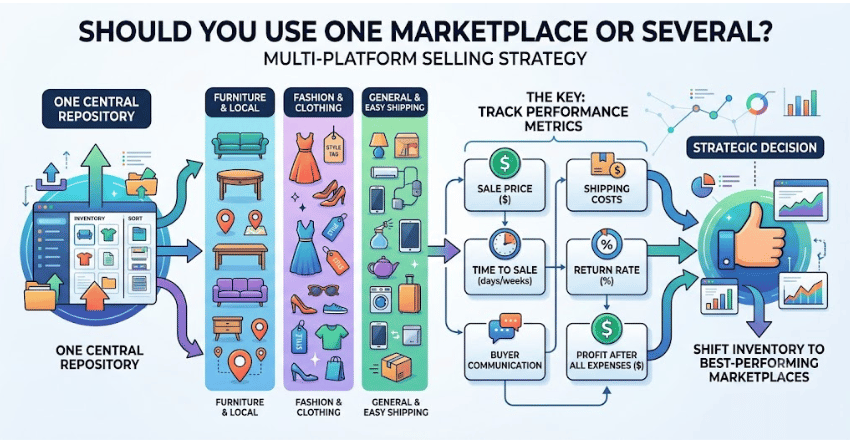
For many sellers, using several platforms is more practical than finding one complete replacement.
A local marketplace may work best for furniture. A fashion-focused platform may perform better for clothing. A general resale marketplace can handle everyday items that are easy to ship.
Cross-listing can also reduce your dependence on one source of buyers.
The key is to measure performance rather than list everywhere without a plan.
Track:
- Sale price
- Seller fees
- Shipping costs
- Time to sale
- Return rate
- Buyer communication time
- Profit after all expenses
After a reasonable test period, shift more inventory toward the marketplaces producing the best results.
Conclusion
For general secondhand goods, Mercari is the strongest first platform to test. Local sellers should start with Facebook Marketplace and consider OfferUp as another local channel. Depop and Poshmark make more sense for fashion. Etsy is the specialist choice for suitable creative and vintage inventory. Whatnot stands out for collectibles and sellers who are comfortable with live commerce.
Bonanza is worth testing when lower base fees and catalog-import features matter, but sellers should measure actual traffic and sales before moving a large amount of inventory. The smartest approach is not to move every listing at once. Test the marketplaces that fit your products, calculate your real net return, and expand only where the results justify the additional work. For more platform comparisons, selling tools, app guides, and technology coverage, explore Techixia.
If you want to know about Galaxy Z Fold5 to Buy in 2026 then visit our Ecommerce category .
Frequently Asked Questions
Mercari is a strong general-purpose starting point for casual U.S. sellers who want nationwide shipping and broad product categories. The better choice depends on your specialty. Fashion, collectibles, handmade products, and local goods each have marketplaces that may be better suited to those products.
There is no universal winner because fee structures and seller locations vary. Depop currently charges U.S. sellers no standard selling fee, although payment processing still applies. Bonanza says its final value fees start at 3.5%. Local selling through Facebook Marketplace may also be attractive when a transaction does not involve marketplace shipping services. Always calculate the total cost of a completed sale rather than comparing one headline percentage.
It can be. Mercari uses a straightforward seller fee structure and is designed around everyday resale. That can make it appealing to casual sellers who want a simpler workflow. The better choice still depends on whether Mercari has strong demand for your products and whether the total buyer cost affects sales.
Choose Depop for trend-driven, vintage, and style-focused inventory. Poshmark is a strong option for broader fashion resale and sellers who prefer its established clothing-focused workflow. Fees should also influence the decision. U.S. Depop sellers currently pay payment processing fees without a standard selling fee, while Poshmark charges 20% on sales of $15 or more.
Facebook Marketplace is the first platform worth testing for most local inventory. OfferUp is another focused local option, particularly for products that are expensive or inconvenient to ship. OfferUp should now be treated as a local-only marketplace because its nationwide shipping program ended in 2025.
Only for the right inventory. Etsy is a strong option for handmade, creative, customized, and qualifying vintage products. It is not designed as a general marketplace for every type of secondhand consumer product.
It can be, particularly if your products benefit from live demonstrations, auctions, or interaction with collector communities. Sellers who prefer fixed-price listings with minimal interaction may find a more conventional marketplace easier to manage.
Cross-listing is usually the safer approach. Put a controlled portion of your inventory on one or two additional marketplaces and measure sales, net margin, time to sale, returns, and workload. Move more inventory only when the results support the decision. A platform with lower fees is not a better sales channel if buyer demand is weak.