
If you searched for a fast background check, you’re likely looking for FastBackgroundCheck.com, a people-search service built around public-record data. It can help with casual lookups, reverse phone searches, and checking your own online footprint. It is not intended for employment, tenant, credit, insurance, or similar eligibility decisions.
| Key question | Short answer |
| What is FastBackgroundCheck? | A people-search and public-record lookup service |
| What can it show? | Addresses, phone numbers, age, email addresses, relatives, and related public-record details |
| Is it free? | The site advertises free people, phone, and address searches |
| Is the information guaranteed to be accurate? | No. The company advises users to verify results |
| Can employers or landlords use it? | Not for eligibility decisions covered by the FCRA |
| Can you remove your information? | Yes. An official opt-out process is available |
FastBackgroundCheck is closer to a people-search database than a formal screening service. It gathers public-record information and makes it searchable by name, phone number, or address. Results can be useful as leads, but the company does not guarantee their accuracy, completeness, or freshness. Important details should therefore be verified independently.
What Is FastBackgroundCheck?

FastBackgroundCheck offers three main types of lookup: people search, reverse phone lookup, and address search. Its website says it searches billions of public records and can return information tied to a name, phone number, or address.
That distinction matters because the brand name can sound like an employment screening service. In practice, its public-facing tools are designed primarily to help users find people and contact details. The site also states that it is not a Consumer Reporting Agency under the Fair Credit Reporting Act.
What a Fast Background Check Can Show
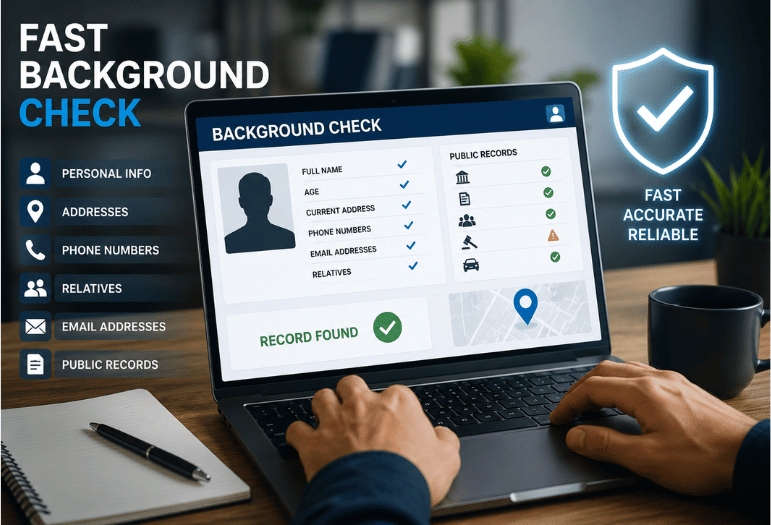
The information available depends on the person and the records associated with them. FastBackgroundCheck says its results may include current and past phone numbers, addresses, age, email addresses, relatives, and known associates.
An address search can also identify current or previous residents associated with a property. Reverse phone lookup is designed to connect an unknown number with available identifying information. This makes the service more useful for contact research than for making high-stakes decisions.
How Accurate Is FastBackgroundCheck?

Treat every result as a lead rather than proof. FastBackgroundCheck says it updates its data regularly, but its own FAQ recommends verifying information found through searches. Its terms also state that it does not guarantee the accuracy, completeness, reliability, or freshness of the available information.
Errors can matter when records involve people with similar names, former addresses, or outdated associations. If a detail is important, check it against an authoritative source or confirm it directly with the person involved.
The service’s privacy-rights guidance follows the same principle. For inaccurate official information, it recommends checking with the relevant state or local record holder.
Is FastBackgroundCheck Legitimate and Safe to Use?
FastBackgroundCheck is an active people-search website with published terms, privacy notices, and an opt-out system. However, that does not mean every result is correct or that every possible use of the information is permitted.
A practical way to evaluate a search is to consider its purpose:
| Use | Appropriate approach |
| Finding an old contact | Use the result as a starting point and verify it |
| Checking an unfamiliar phone number | Compare the result with other reliable information |
| Searching your own online footprint | Review what information about you is publicly visible |
| Deciding whether to hire someone | Do not use FastBackgroundCheck for this purpose |
| Approving a tenant | Do not use it for housing eligibility decisions |
| Deciding credit or insurance eligibility | Do not use it for these decisions |
The site’s current terms also prohibit stalking, harassment, and other harmful uses of personal information.
Can Employers or Landlords Use It for Screening?
FastBackgroundCheck specifically prohibits using its information to determine eligibility for employment, volunteering, housing, credit, insurance, government benefits, and other purposes covered by the FCRA.
Formal screening is a different process. Employers that use companies to compile background information must follow FCRA requirements when reports are used for employment decisions. These requirements can include disclosure, authorization, and procedures related to adverse decisions.
Landlords may also have FCRA obligations when using consumer reports for rental decisions. A casual people-search result should not be used as a substitute for an appropriate tenant-screening report.
Privacy and the FastBackgroundCheck Opt-Out Process
Seeing your home address, phone number, or relatives listed on a people-search site can be uncomfortable. FastBackgroundCheck provides an official removal process and states that users should allow up to three days after completing a request for a record to be removed.
To submit a request:
- Open the official opt-out form, provide your name and email address, and complete the CAPTCHA.
- Open the verification email and follow the link within 24 hours.
- Enter information that matches the record you want removed.
- Confirm the request and keep the confirmation email for your records.
Removal from the website does not erase the underlying public record. FastBackgroundCheck states that it regularly receives new public records, so previously removed information could appear again. Its privacy guidance recommends refreshing an opt-out request periodically if needed.
How to Use People-Search Results Responsibly

Start by confirming the person’s identity before trusting any match. A name and city alone may not be enough. Compare age, previous locations, contact details, and other independent information before deciding that a record belongs to the person you are searching for.
Protect your own information as well. Techixia’s cybersecurity coverage offers broader guidance on protecting devices, data, and accounts. Its authentication section covers identity verification and account security, while the Free antivirus guide for 2026 can help you strengthen device protection.
If you find your own information on a people-search service, review the record for errors and consider opting out. Managing your privacy works best as a periodic habit rather than a one-time task.
The Bottom Line
FastBackgroundCheck can be useful when you need a quick people, phone, or address lookup. The safest approach is to treat its results as leads, verify important details independently, and never use the service for regulated eligibility decisions that its terms prohibit.
You can also search your own name to see what information is publicly visible. If a record exposes information you would rather not have readily searchable, use the official opt-out process and check again periodically.
Frequently Asked Questions
FastBackgroundCheck currently advertises free people searches, reverse phone lookups, and address reports based on public records. Other offers or third-party services may appear while you use the site, so check what you are opening before providing payment information.
No. The company says its data is updated regularly and recommends verifying results. Its terms also state that it does not guarantee the accuracy, completeness, reliability, or timeliness of the available information.
FastBackgroundCheck says its searches are anonymous. Its privacy notice also states that search criteria are not stored in a way that identifies who performed the search. This reflects the company’s stated data practices rather than an independent privacy guarantee.
Not for an employment eligibility decision. The company’s terms prohibit that use, and employment reports obtained from screening companies may be subject to specific FCRA requirements.
Yes, it may. The company explains that opting out does not remove information from the original public source. Later public-record updates can therefore cause the information to appear again.