

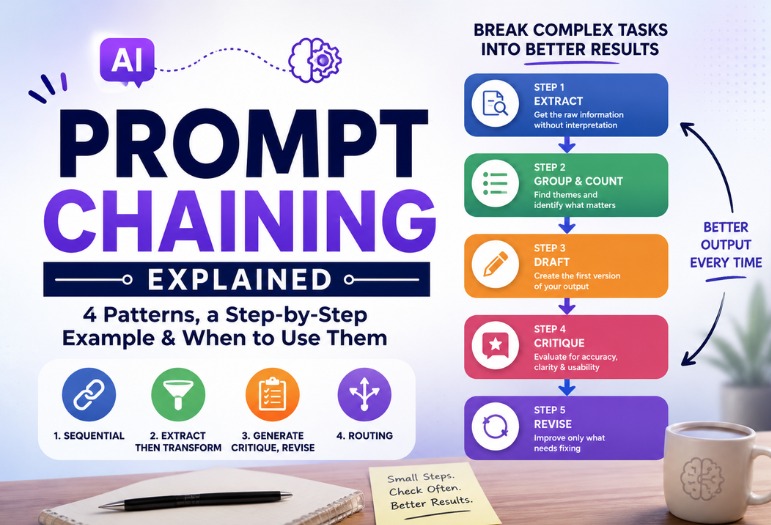
Prompt chaining means breaking a complex task into a sequence of smaller prompts, where each step’s output feeds into the next, rather than asking for everything at once. You step one, read what comes back, correct it if you need to, then hand it to step two. Slower per request, far better per result. Below is a chain you can copy today, the four patterns worth knowing, and the jobs where a single prompt still wins.
| Question | Short answer |
| What it is | One task split into ordered prompts, each fed by the last |
| Best for | Long documents, messy feedback, anything that needs a review step |
| Worst for | One-line answers, quick rewrites, simple lookups |
| Typical length | Three to five steps |
| Main cost | More waiting, and more tokens per finished piece |
| Where it runs | ChatGPT, Claude, Gemini, or Copilot, no code required |
Key takeaways
- Each step is small enough to check before it matters, so a bad answer stops early.
- Four patterns cover nearly every real chain: sequential, extract-then-transform, generate-then-critique-then-revise, and routing.
- Chaining a one-line task wastes time and tokens for nothing.
- It is not the same as chain-of-thought prompting, which happens inside a single prompt.
- Most failures happen at the handoff between steps, not inside a step.
Why does one long prompt keep letting you down?
Ask a model to read 60 survey responses, find the themes, rank them, write a summary, and suggest three actions. What lands is one block of text with no seams. If the themes are wrong, everything downstream is wrong too, and you cannot see where it slipped, so you rewrite the whole request and roll the dice again.
Splitting the job fixes that, and the size of the difference has been measured. A 2022 arXiv paper from Google researchers, later published at ICLR, tested least-to-most prompting, which breaks a problem into ordered subproblems and solves them in order. On the SCAN benchmark, GPT-3 reached at least 99% accuracy with that method, compared with only 16% for chain-of-thought prompting inside a single prompt.
Three things change once the work is split. Each step is small enough to check. An error stops at the step that made it rather than compounding through four more. And the model keeps its attention on a single instruction rather than six. It is the same logic as fixing a weak WiFi signal: one change at a time; move five things at once, and you never learn which one helped.
A worked example you can copy: 60 survey comments to a one-page brief
Say you have exported 60 open-text comments from a customer survey, and your manager wants one page by Friday. Paste the comments into a normal chat window, then run these five prompts in the same conversation. Each one is short on purpose.
- Extract, no interpretation. Prompt: “From the comments below, pull every distinct complaint as a short verbatim quote. One per line. Do not group or explain them yet.” Read the list. An invented quote gets caught here, in step one, where it costs you nothing.
- Group and count. Prompt: “Group that list into themes. Give each theme a plain name, a count, and two example quotes. Rank the themes by count.” Check the counts against your 60s.
- Draft the brief. Prompt: “Write a one-page brief for a non-technical manager from the ranked themes. Cover the headline problem, the top three themes with their counts, and three actions we could take this quarter. Under 400 words.”
- Critique it. Prompt: “Score that brief out of 5 for accuracy against the source quotes, for clarity, and for how usable the actions are. List every weak sentence and say why.” Asked separately, the criticism is genuine.
- Revise narrowly. Prompt: “Rewrite the brief fixing only the issues you listed. Change nothing else.” That last clause is what stops a rewrite of the parts that were already fine.
The whole run takes about ten minutes. Swap the survey comments for support tickets, meeting notes, or the transcript of a clip you are cutting in free video editing software, and the five steps hold.
Four chain patterns and what each one is good for

Nearly every useful chain is one of four shapes, or two of them stitched together. Pick based on what the task needs, not on what sounds thorough.
| Pattern | How it runs | Good for | Watch out for |
| Sequential | Step one feeds step two feeds step three | Long documents, research write-ups, work with a fixed order | A wrong early step quietly shaping everything after it |
| Extract then transform | Pull the raw facts first, reshape them second | Data buried in messy text: invoices, reviews, transcripts | An extraction step that paraphrases instead of quoting |
| Generate, critique, revise | Draft it, score the draft, rewrite from the notes | Writing, code review, work where quality beats speed | A model praising its own draft when the critique prompt is vague |
| Routing | One prompt classifies the input, then sends it down the right path | Mixed inboxes, support queues, varied file types | A loose classifier that drops everything in one bucket |
Both routing and the critique loop carry over to visual work. Classify the request first, send it to the right AI image generation tools, then ask for a written list of what looks wrong before you regenerate anything.
When prompt chaining is the wrong call?

Chaining a simple task makes it slower and more expensive for no gain. Every extra step is another round trip, another wait, and on a paid plan another slice of your monthly usage. ChatGPT Plus costs $20 a month, and a five-step run eats through that allowance far faster than a single prompt does. Skip the chain in these cases.
- The task fits one clear instruction: a rewrite, a translation, and a summary of two paragraphs.
- You need it now, and roughly right beats slowly perfectly.
- There is no real handoff, so step two would ignore whatever step one produced.
- The job runs hundreds of times on a metered plan, and the token cost multiplies.
- A reasoning model already decomposes the problem internally, so your steps duplicate its work.
Here is a quick test. If you cannot name what step two receives from step one, you do not have a chain; you have two prompts in a row.
How does chaining differ from chain-of-thought and few-shot prompting?

Readers constantly mix these three up, and they solve different problems. Chain-of-thought prompting happens within a single prompt: you ask the model to reason step by step, and it shows its work before it answers. Few-shot prompting also works with a single prompt, where you paste two or three examples of the input and the desired output, so the model learns the pattern.
Chaining is the only one of the three that runs across separate turns, which is why you can see each intermediate result, edit it, or stop. That visibility is the point. The AI Chains study, run with 20 participants and published in 2022, found that chaining improved the quality of task outcomes. Its participants also debugged their work by unit-testing single steps rather than rewriting the whole request.
Where do errors creep in between steps?

Chains break at the joins. A number invented in step one reads like a settled fact by step four, because every later prompt treats the last output as ground truth. Five habits catch almost all of it.
- Read the output of step one before you step two. Every time. It is the cheapest check available.
- Tell each extraction step to quote rather than paraphrase, since paraphrase is where numbers drift.
- Keep counts and proper names in your prompt text, so a later step cannot quietly change them.
- Spot-check anything that reads like a statistic against the source or against trusted tech review sites.
- Start a fresh conversation when a chain runs long, because old turns drag the model back toward earlier, wrong output.
Two minutes of reading between steps beats an hour tracing a bad brief backwards.
Try it on one task this week.
Pick something you already do badly with a single prompt: the weekly summary, a first draft, a pile of feedback nobody has read. Split it into three prompts, run them in order, and compare the result against your old one-shot version. That comparison is the whole practice, and it takes one afternoon to learn.
Apart from that, if you want to know about QTCinderella Deepfake, check out the AI Tools category.
Frequently asked questions (FAQs)
No. An agent picks its own next step. A chain is a sequence you decided in advance and can predict. Agents are chains that choose their own paths, which buys flexibility but costs you certainty.
Three to five covers most everyday work. Past that, the waiting adds up, and stale context starts pulling results backwards. Split a long job into two shorter chains instead of one long one.
Yes, on both counts. Context gets resent with each step, so a five-step run can cost several times as much as a single prompt, and free tiers hit their message limits faster. What you buy back is fewer wasted retries.
Every step above runs by typing into a normal chat window. Automation tools help once you repeat the same chain daily, though nothing here requires them.
No. They handle the thinking within a single answer well. What they still cannot do is show you a checkable list halfway through, which is exactly what you want when the input is messy.
Take the last prompt that gave you a disappointing answer. Split it at the first “and”, run the two halves in order, and keep whichever version reads better.