
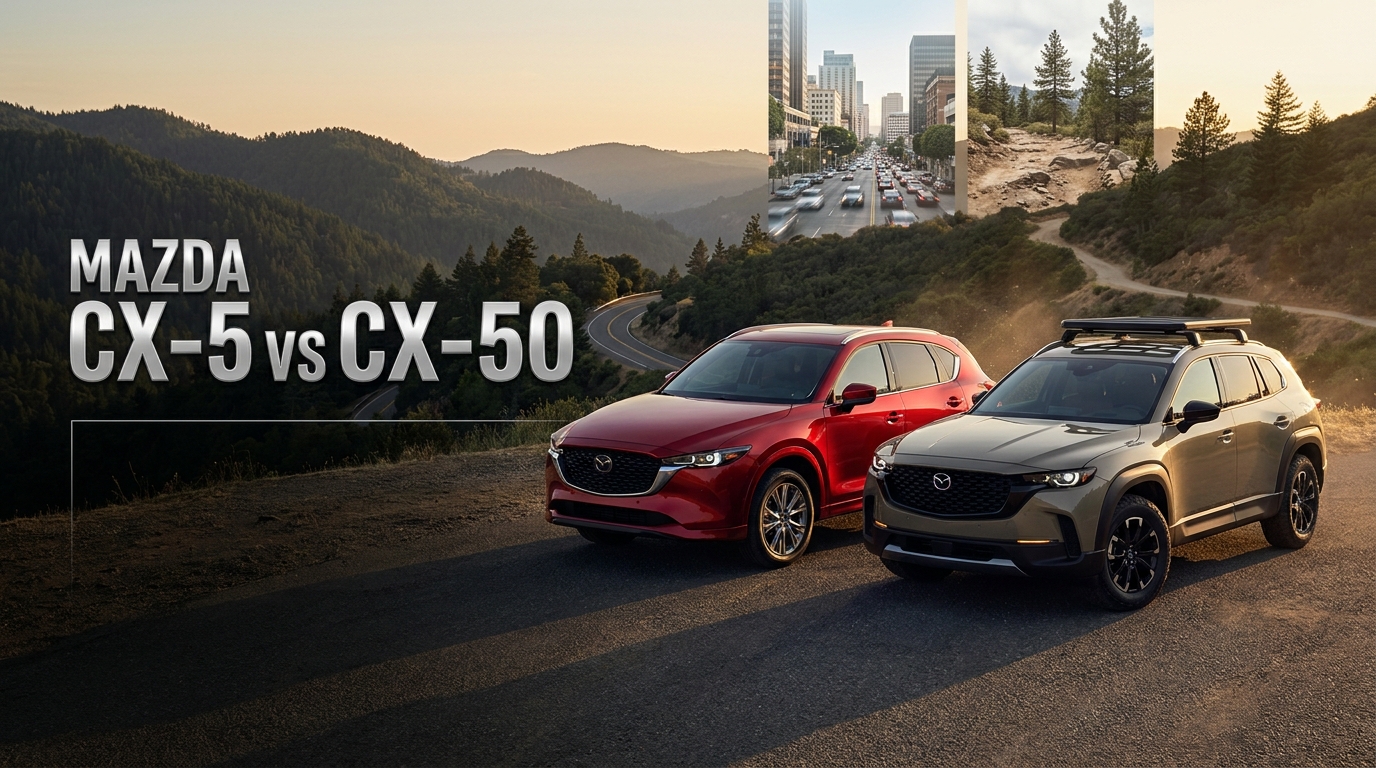
The Mazda CX-5 vs CX-50 decision comes down to how you plan to use your SUV. Choose the CX-5 for a roomier cabin, larger touchscreen, and family-friendly design. Choose the CX-50 for stronger engines, better towing, a hybrid option, and added capability on rough roads. CX-5 vs CX-50 is a useful companion read here.
Both are five-seat compact SUVs with standard all-wheel drive. Their base prices and standard fuel economy are also almost identical. Yet their personalities, powertrain choices, and practical strengths differ enough to make one a much better match for certain buyers.
| Key difference | 2026 Mazda CX-5 | 2026 Mazda CX-50 |
| Best suited to | Families, commuting, daily comfort | Active lifestyles, towing, varied terrain |
| Starting MSRP | $29,990 | $29,900 |
| Standard engine | 2.5-liter four-cylinder | 2.5-liter four-cylinder |
| Standard output | 187 horsepower | 187 horsepower |
| Other powertrains | None for 2026 | Turbo and hybrid |
| Standard combined economy | 26 mpg | 26 mpg |
| Hybrid economy | Not available for 2026 | 38 mpg combined |
| Maximum towing capacity | 1,500 pounds | Up to 3,500 pounds |
| Standard drivetrain | All-wheel drive | All-wheel drive |
| Main screen | 12.9 inches; 15.6 available | 10.25 inches |
| Main advantage | Passenger space and newer technology | Powertrain choice and capability |
Prices exclude destination charges, taxes, registration, options, and dealer adjustments. Mazda lists the CX-5 from $29,990 and the CX-50 from $29,900.
Mazda CX-5 vs CX-50: The Quick Verdict
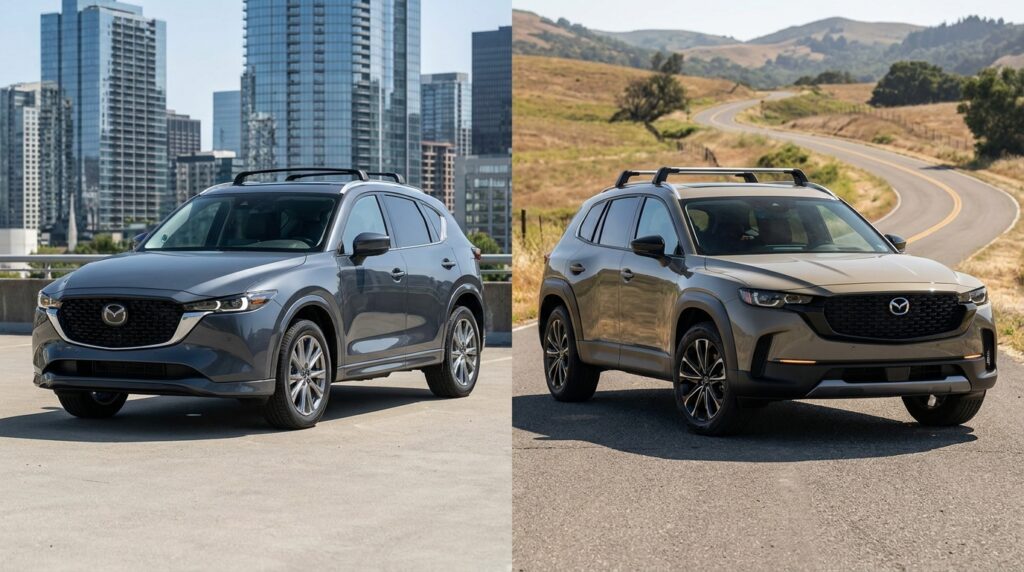
The CX-5 is our pick for most families and everyday drivers. Its redesign brings more passenger room, larger door openings, better rear-seat access, and a much larger infotainment display.
The CX-50 is the better purchase for drivers who want faster acceleration, higher towing limits, a fuel-saving hybrid, or extra ground clearance. It also has styling and equipment aimed at outdoor use.
Neither model wins every category. Your ideal choice depends on whether comfort and cabin usability matter more than powertrain variety and utility.
Price and Trim Choices
Base pricing won’t settle the decision. The CX-50 starts only $90 below the CX-5 before destination fees.
Mazda offers the CX-5 in five trims. Prices begin at $29,990 for the 2.5 S and rise to $38,990 for the 2.5 S Premium Plus. Every version uses the same naturally aspirated engine and all-wheel-drive system.
The gas-powered CX-50 has seven trims. Mazda lists prices from $29,900 for the 2.5 S Select to $42,900 for the Turbo Premium Plus. Buyers can choose standard, Meridian, premium, and turbo configurations.
A CX-50 Hybrid is also available. It begins at $34,750, giving fuel-conscious buyers an option the 2026 CX-5 lineup lacks. Mazda says a CX-5 hybrid is planned for 2027.
Price winner: Tie
The CX-50 costs slightly less at entry level. The difference is too small to shape a sensible buying decision.
Space, Seating, and Family Use
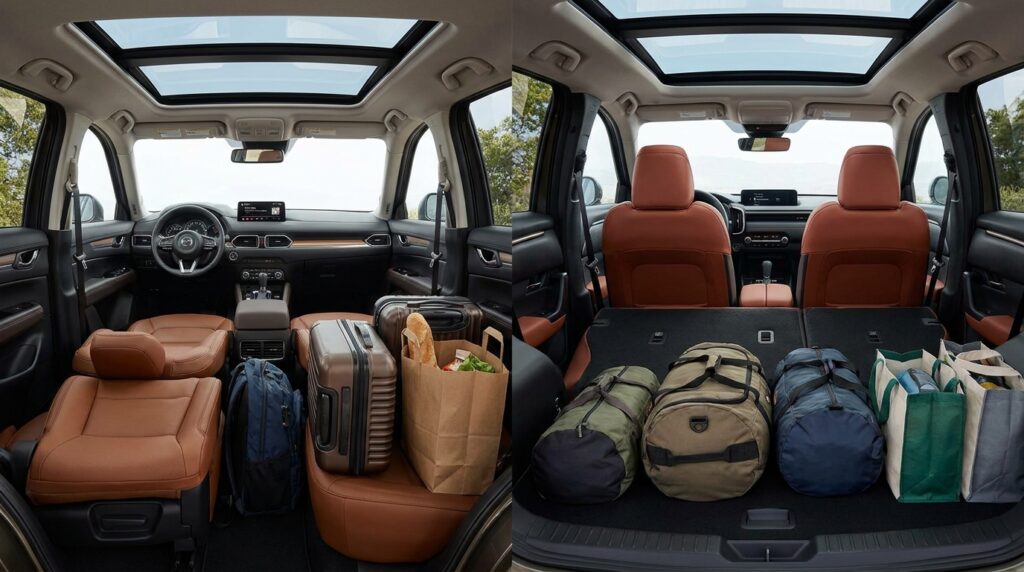
Mazda substantially enlarged the CX-5 for 2026. The redesigned model is 4.5 inches longer in both overall length and wheelbase than its predecessor. It is also more than half an inch wider.
Those changes created more rear legroom, knee room, and headroom. Mazda also increased the size of the door openings, which should make it easier to load children or install car seats.
The CX-50 is lower and wider, with a more athletic shape. Its lower roof contributes to a sportier appearance, but the CX-5 provides slightly more passenger space and headroom. The two models now share the same wheelbase.
That makes the CX-5 more appealing for:
- Parents using rear-facing child seats
- Adults who often ride in the second row
- Taller passengers who value headroom
- Drivers who prefer a more upright seating position
- Households that use one vehicle for most daily tasks
The CX-50 still seats five and offers useful cargo space. Its lower and wider proportions may also help when loading certain long or bulky items.
Space winner: CX-5
The redesigned cabin gives it a practical advantage for passengers and family use.
Performance and Engine Options
The standard versions are closely matched. Both use a naturally aspirated 2.5-liter four-cylinder engine with 187 horsepower and a six-speed automatic transmission. All-wheel drive comes standard.
The difference appears when you move beyond the base engine.
The CX-50 offers a turbocharged 2.5-liter engine. It produces up to 256 horsepower and 320 pound-feet of torque when using premium fuel. Its stronger acceleration makes it the clear choice for drivers who find the standard engine too relaxed.
The CX-50 Hybrid uses a 2.5-liter gasoline engine, three electric motors, an electronic continuously variable transmission, and electric all-wheel drive. Its system produces 219 horsepower.
The 2026 CX-5 has no turbo or hybrid option. Every trim uses the 187-horsepower engine. That simplifies the lineup, but it also limits buyers who want stronger performance.
Performance winner: CX-50
Its turbo and hybrid choices give buyers more flexibility.
Fuel Economy
Standard gasoline models produce similar EPA estimates.
Mazda rates the CX-5 at 24 mpg in the city, 30 mpg on the highway, and 26 mpg combined. The naturally aspirated CX-50 carries the same estimates.
The turbocharged CX-50 drops slightly to 25 mpg combined. That is a modest penalty given its substantial power increase.
The hybrid changes the calculation. Mazda rates it at 38 mpg combined and estimates a total driving range of 551 miles. Drivers with long commutes or high annual mileage may recover part of the higher purchase price through lower fuel use.
Fuel-economy winner: CX-50 Hybrid
The standard gas models tie, but only the CX-50 offers a high-efficiency version for 2026.
Towing and Outdoor Capability
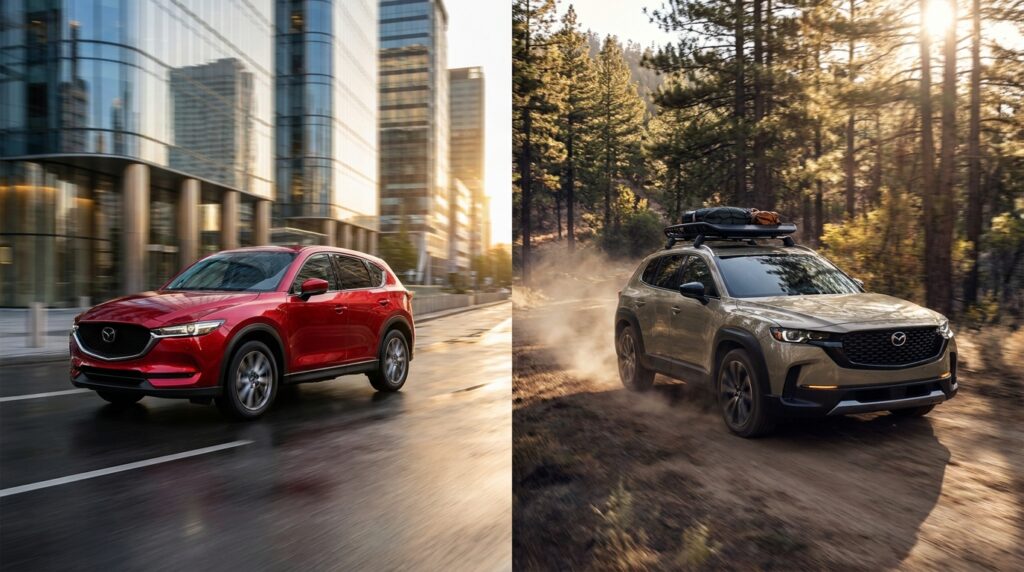
The CX-50 is the stronger towing vehicle. A turbocharged model can tow up to 3,500 pounds when properly equipped. The naturally aspirated version is rated for up to 2,000 pounds. The CX-50 Hybrid and CX-5 each have a 1,500-pound limit.
Ground clearance also favors the CX-50. It provides 8.3 inches, compared with 7.6 inches for the CX-5. The added clearance can reduce the chance of scraping the underside on uneven trails or rough access roads.
Meridian Edition models add an outdoor-focused appearance and equipment. For 2026, Mazda offers a naturally aspirated Meridian trim with 18-inch wheels, all-terrain tires, and black roof rails.
Neither SUV is intended to replace a dedicated off-road vehicle. Still, the CX-50 is better prepared for gravel roads, campsites, small trailers, and outdoor equipment.
If you enjoy performance cars, don’t miss our 2022 Subaru WRX Review, and explore the Technology category on Techixia for more automotive reviews, buying guides, and the latest tech insights.
Capability winner: CX-50
It has the higher towing limit, greater ground clearance, and more adventure-oriented trim choices.
Interior Technology and Controls
The CX-5 has Mazda’s newer infotainment system.
Lower trims use a 12.9-inch touchscreen with Google built-in. The Premium Plus receives a 15.6-inch display. Mazda also offers wireless Apple CarPlay and Android Auto on relevant trims.
The CX-50 uses a 10.25-inch display with Mazda Connect. It supports wireless Apple CarPlay and Android Auto, Alexa Built-in, USB-C ports, and a wireless phone charger. A console-mounted commander knob remains part of the control system.
Which setup feels better is partly personal.
The CX-5’s larger screen offers clearer maps and a more modern visual experience. Yet many vehicle functions have moved into the touchscreen. Drivers who prefer physical controls may favor the CX-50’s older layout and rotary controller.
Technology winner: CX-5
Its display is larger, and its software is newer, though the CX-50 may suit drivers who like physical controls.
CX-5 Pros and Cons
Pros
- More passenger room and headroom
- Easier rear-seat access
- Large 12.9-inch standard touchscreen
- Available 15.6-inch display
- Straightforward five-trim lineup
- Competitive starting price
- Standard all-wheel drive
Cons
- No turbocharged engine for 2026
- No hybrid until the planned 2027 model
- Lower towing capacity
- Less ground clearance
- Touchscreen-centered controls may not suit every driver
CX-50 Pros and Cons
Pros
- Standard, turbo, and hybrid powertrains
- Up to 3,500 pounds of towing capacity
- Hybrid delivers 38 mpg combined
- More ground clearance
- Adventure-oriented Meridian trims
- Traditional infotainment commander control
- Slightly lower starting price
Cons
- Less headroom and passenger space
- Smaller center display
- Turbo and hybrid versions cost more
- Lower roofline may feel less open
- Top trims cost more than the highest CX-5 trim
Explore more expert reviews and tech insights in the Technology category on Techixia.
Which Mazda SUV Should You Buy?
Buy the CX-5 if comfort, rear-seat space, technology, and daily usability lead your priorities. It suits commuters, small families, and buyers who want an upscale compact SUV without paying for extra towing power.
Buy the CX-50 if you tow, travel on rough roads, or want stronger acceleration. It also makes more sense when a hybrid is essential.
Here is a simple decision shortcut:
- Choose the CX-5 for school runs, commuting, passenger comfort, and newer infotainment.
- Choose the CX-50 Turbo for towing and faster performance.
- Choose the CX-50 Hybrid for lower fuel consumption.
- Choose a Meridian Edition for outdoor-focused tires and styling.
- Wait for the planned 2027 CX-5 Hybrid when you prefer the CX-5 cabin but want electrification.
The CX-5 earns the general recommendation because its strengths benefit more drivers every day. The CX-50 becomes the better purchase when you need one of its specialized advantages.
Questions to Ask During a Test Drive
A specification sheet can narrow the choice, but a test drive should settle it. Check the following points before signing:
- Can adults enter the rear seat without ducking or twisting?
- Is there enough space for your child seat or regular passengers?
- Do you prefer the CX-5 touchscreen or CX-50 commander knob?
- Does the standard 187-horsepower engine feel strong enough?
- Will you tow more than 1,500 pounds?
- Is the hybrid’s fuel saving worth its higher price?
- Can your usual cargo fit behind the second row?
- Are the seats comfortable after at least 20 minutes?
Drive both vehicles over the same roads when possible. Include highway merging, parking, uneven pavement, and a tight turning area.
Final Verdict
The Mazda CX-5 vs CX-50 choice has a straightforward answer for most shoppers. Pick the CX-5 when your SUV will spend most of its time carrying people through cities, suburbs, and highways. Its roomier cabin, easy rear access, and larger display make it the stronger everyday vehicle.
Pick the CX-50 when your plans involve trailers, outdoor gear, rougher roads, or a desire for turbocharged or hybrid power. Its broader lineup lets you buy a more specialized vehicle.
Before buying, test the exact trims you are considering. Equipment, wheel size, seat materials, and powertrain choices can affect the driving experience as much as the model name.
If you want to know about Best JDM Cars then visit our Technology category.
Frequently Asked Questions
The CX-5 focuses on passenger comfort, cabin space, and newer infotainment. The CX-50 emphasizes stronger powertrain options, towing capability, hybrid efficiency, and increased ground clearance.
The CX-50 has a lower, wider profile and is slightly longer overall. The redesigned CX-5 now shares its wheelbase and provides a little more passenger room and headroom.
The redesigned CX-5 offers increased cargo capacity compared with its previous generation. Available independent comparisons also report that it provides more cargo room than the CX-50, though usable space can depend on cargo shape.
Both have standard all-wheel drive. The CX-50’s extra ground clearance may help in deeper snow, while tires remain a major factor in winter traction.
Not for the 2026 model year. Mazda says a hybrid CX-5 is confirmed for launch in 2027.
The CX-50 Turbo can tow up to 3,500 pounds when properly equipped. The CX-5 is rated for up to 1,500 pounds.
It can be worthwhile for drivers who cover many miles and want better fuel economy. Its 38-mpg combined estimate is 12 mpg higher than the standard gas models. Compare the purchase-price difference with your expected fuel savings.