

Coupon AI is the label now stuck on any tool that hunts promo codes and tries them at your checkout. Almost every one of them is free to install. They pay for themselves by taking an affiliate commission on the purchase you were already making. That trade can be worth it, as long as nobody hides it from you.
Here’s the short version. These tools collect discount codes from stores, affiliate feeds, and other shoppers. At checkout, they fire the codes at the promo box one at a time, then keep whichever knocks the most off your total. Most codes fail. The savings are real but modest, and the price you pay is in permission rather than dollars.
| What you want to know | The short answer |
| What is Coupon AI | A browser extension or website that finds and auto-tests discount codes |
| US price | $0. Every major option is free to install and free to use |
| How it earns | Affiliate commission on your purchase, sometimes shared back as cash back |
| Biggest US names | PayPal Honey, Capital One Shopping, Rakuten, Coupert, Karma |
| Main risk | Extensions that can read and change every page you open |
| Realistic saving | A few dollars on a big-retailer order, nothing on many small ones |
Key takeaways
- Nothing here costs money. The product is the commission, and sometimes the data.
- Capital One Shopping and Rakuten publish plain statements about how they earn.
- Honey’s store listing discloses that it handles financial and payment information.
- A federal lawsuit filed in December 2024 put affiliate credit at the center of the argument.
- Your browser may already do half the job without a third-party add-on.
What coupon AI covers, because the term means two things

Search Coupon AI and you get two different result sets stacked on top of each other. One is the broader category of shopping extensions that use automation and machine learning to collect, rank, and test discount codes. The other is a group of specific products that use the same name.
Those small extensions are not the same thing as the big shopping platforms. One I checked had 115 users. Another had 9,000. Both sit next to Honey’s 12 million in the same store, behind the same install button.
How the code hunting works
There is less magic here than the marketing suggests. These tools scrape retailer pages, pull codes from affiliate networks, buy feeds from coupon sites, and take submissions from their own users. A ranking model guesses which codes will work on a given store.
At checkout, the extension pastes them in, one at a time, reading the order total after each attempt. It keeps the winner and discards the rest. Coupon.ai, which is a website rather than an add-on, claims to test more than 690,000 codes a day this way.
Automated testing is the genuinely useful part. Typing eight dead codes yourself takes five minutes; the extension does it in seconds. That’s the same deal as a good free antivirus product that earns its keep quietly. It raises the same question: who is paying for the free thing?
Six options compared
| Tool | Free? | Strongest at | How it pays itself | Watch out for |
| PayPal Honey | Yes | Coverage, 30,000+ sites, price tracking via Droplist | Affiliate commission, PayPal Rewards | Discloses handling financial and payment information |
| Capital One Shopping | Yes, no card needed | Code testing plus price comparison across sellers | Merchant commission, partly returned as rewards | Rewards are credits, not cash to your bank |
| Rakuten | Yes | Cash back, 17 million members, $3.6 billion paid since 1999 | Brands pay for customers; a share goes to you | Payouts land quarterly, not instantly |
| Coupert | Yes | Rate transparency, 8.75 million users | Affiliate programs, stated openly on its site | Cashback ranges swing wildly by store |
| Karma | Yes | Price-drop alerts and wishlists | Commission on purchases through its links | Savings claims are self-reported averages |
| Coupon.ai | Yes | Browsing codes without installing anything | Affiliate links on outbound clicks | No extension, so no checkout automation |
Our pick for most US shoppers is Capital One Shopping. It applies codes, compares the same item across sellers, and states its commission arrangement on its own homepage. Rakuten is the better second install if you buy from big brands often, because the cash back is worth more than a code hunt. Skip the tiny AI-branded add-ons entirely.
How free coupon extensions make money

Every one of these companies is paid by the store, not by you. Capital One Shopping says it “earns a commission when you make eligible purchases from merchants” and may share those commissions back as rewards. Coupert is equally direct, saying it “uses affiliate programs for monetization” and may receive a commission on outbound links.
Rakuten describes partnering with brands who pay it to bring them customers, then splitting that payment with members. Here’s why that matters. The commission usually goes to whoever sets the last tracking cookie before you pay. An extension that pops up at checkout is standing in exactly that spot.
The affiliate credit lawsuit
In December 2024, video creators including Wendover Productions took PayPal to federal court in California over Honey. The consolidated case, In re PayPal Honey Browser Extension Litigation, No. 5:24-cv-09470, is filed in the Northern District of California.
They allege the extension replaced their affiliate tracking with its own now-of-purchase, diverting commission they had earned. Those are allegations. No court has ruled on them, and PayPal has not been found liable. Even so, the case is the clearest public airing of how this money moves.
What data and permissions do they request?
To test a code in your cart, an add-on needs to read and change the page you’re on. Chrome states the permission plainly: “Allow this extension to read and change all your data on websites you visit.” You can narrow that to specific sites, or to on-click, in the extension details panel. Almost nobody does.
Look at what the developers themselves declare in the Chrome Web Store. Honey’s listing discloses six categories: personally identifiable information, financial and payment information, location, web history, user activity, and website content. Capital One Shopping’s listing names four, leaving financial information and web history off.
Why so many promo codes fail at checkout
Because most of them were never meant for you. Codes carry exclusions on sale items and named brands. They carry expiry dates the aggregator hasn’t caught up with, one-per-customer limits, and minimum spends. Some carry region locks that quietly kill them at a US address. Fast Background Check is a useful companion read here.
Retailers also rotate codes to stop exactly this kind of automated hunting. A banner promising “up to 30% off” is a marketing claim about the single best code in the pile, not a forecast for your cart. A realistic result on a $120 order is a few dollars, or nothing at all. Treat a hit as a small bonus.
Is it safe to install a coupon extension?
Reasonably, if you pick carefully. Run through this before you click Add:
- Check the developer’s real name and website in the store listing.
- Read the disclosed data categories, then decide if financial information belongs there.
- Prefer tools with more than a million users and a visible privacy policy.
- Set site access to on-click, or to your ten regular shops, instead of every site.
- Review your installed add-ons every few months and remove what you stopped using.
Keep real-time protection running underneath all of it. A malicious add-on is still software on your machine, which is where a paid antivirus suite with browser protection earns its subscription. The same permission discipline applies on your phone, where the hidden Google Play Store settings control what installed apps can reach.
The free alternative most people forget
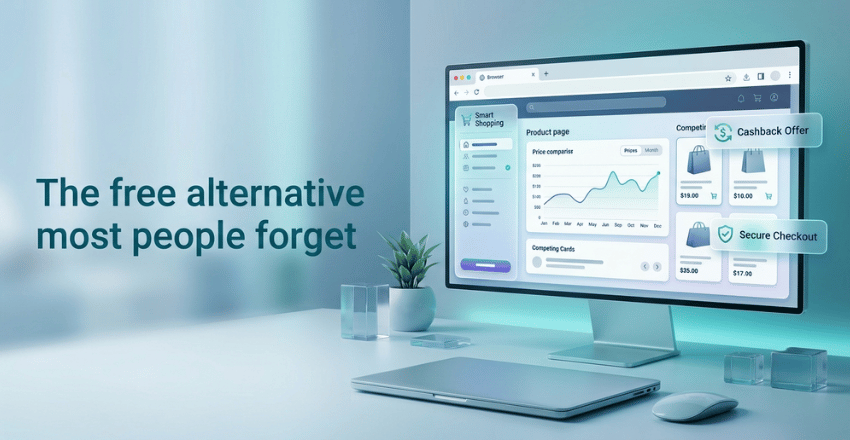
Microsoft Edge ships a shopping panel already. It compares prices on products you’re browsing, tracks price history and handles cash back, with nothing extra installed and no new permission granted. It won’t stuff codes into a promo box for you, but it covers the price-comparison half of the job.
Free tools with a business model behind them are normal now, and not automatically bad. Plenty of free video editing software worth using works the same way. You just want to know what the trade is before you agree to it.
FAQs
Yes. Honey, Capital One Shopping, Rakuten, Coupert, and Karma all install and run at no charge, and none of them ask for a card to sign up.
Slightly, on checkout pages, while they cycle through codes. Expect a delay of a few seconds. Background price tracking is the part that costs more memory.
It does. Honey is part of PayPal and still searches more than 30,000 sites, with about 12 million users on its Chrome listing.
You can install two, but only one will win the affiliate credit, and they can collide in the same promo field. Pick one for codes and one for cash back.
Timing. Rakuten pays quarterly by PayPal, Bilt points, or check, so money you earn in March may not arrive until months later.