


Stick drift can turn a good controller into a frustrating one. A Hall Effect joystick uses magnetic sensing instead of sliding electrical contacts to track movement. That design removes one common wear point behind controller drift.
A Hall Effect stick measures position with magnets and a Hall sensor instead of sliding electrical contacts. That contactless design removes one major wear source behind stick drift. It does not make a controller failure-proof, because springs, gimbals, calibration, firmware, and physical damage can still affect centering.
| Key point | What it means |
|---|---|
| Sensing method | A magnet moves relative to a Hall sensor. |
| Physical sensor contact | None during position sensing |
| Main benefit | Less wear at the position-sensing point |
| Drift resistance | Better resistance to wear-related drift |
| Main limitation | Mechanical parts and calibration can still cause problems. |
| Main alternative | TMR magnetic sensing |
| Best fit | Gamers prioritizing controller durability and consistent stick response |
Key takeaways
- Hall sensing removes the rubbing electrical contact used by traditional potentiometers.
- It reduces a common cause of drift but cannot prevent every controller problem.
- Good calibration, firmware, dead zones, and mechanical construction still matter.
- TMR is another contactless magnetic technology appearing in newer controllers.
- Buyers should judge the entire controller, not the sensor label alone.
How a Hall Effect Joystick Works
A traditional analog stick usually measures each axis through a potentiometer. A small contact moves across a resistive track as you tilt the stick. Repeated movement can gradually wear those contact surfaces.
Hall sensing replaces that electrical contact with magnetic position measurement. Movement changes the magnet’s position relative to the sensor. The electronics convert that magnetic-field change into a position signal for the controller.
The key difference is therefore contact versus contactless sensing. Honeywell uses the same principle in non-contact rotary position sensors. Its documentation notes that solid-state Hall sensing avoids the contact wear found in sliding designs.
Why Traditional Controller Sticks Develop Drift
Stick drift occurs when a controller reports movement while the stick should be centered. Worn potentiometer tracks can create incorrect electrical readings after repeated use. The game then interprets those readings as unwanted movement.
Wear is not the only possible cause of poor centering. Springs can weaken, mechanical parts can loosen, and contamination can affect movement. Calibration errors or firmware behavior can also change what reaches the game.
That distinction matters when shopping for a new controller. Magnetic sensing targets one significant failure mechanism rather than every possible failure. A controller can still develop problems elsewhere in its stick assembly.
Hall Effect Benefits and Their Real Limits
The biggest advantage is reduced wear within the sensing system. There is no electrical wiper repeatedly scraping across a resistive track. That makes magnetic sensing attractive for players concerned about long-term drift.
A magnetic sensor does not automatically make one controller superior. Firmware, calibration, spring tension, dead zones, and construction quality influence the final experience. Techixia’s broader controller guide makes the same distinction between sensor technology and total controller quality.
For broader buying guidance, see Techixia’s What Is a Hotspot guide. It covers platform support, connection types, layouts, software, and magnetic stick technologies.
Hall Effect vs. Potentiometer vs. TMR
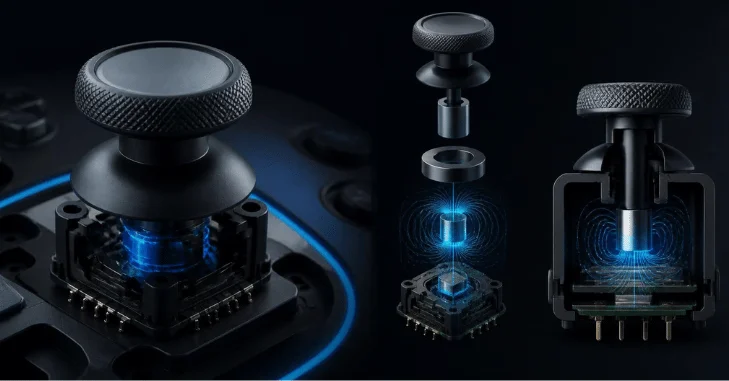
Modern buyers increasingly see three sensor types discussed together. Potentiometers remain common, while Hall and TMR designs use contactless magnetic sensing. Their underlying technologies and practical trade-offs are different.
| Feature | Potentiometer | Hall Effect | TMR |
|---|---|---|---|
| Position sensing | Sliding electrical contact | Magnetic field | Magnetic resistance |
| Contact at sensing point | Yes. | No | No |
| Wear-related drift risk | Higher | Lower | Lower |
| Mechanical parts remain. | Yes. | Yes. | Yes. |
| Calibration matters. | Yes. | Yes. | Yes. |
| Power characteristics | Established baseline | Depends on design | Often designed for lower power |
| Market position | Traditional | Widely used alternative | Newer premium alternative |
TMR means tunneling magnetoresistance. Like Hall sensing, it can read movement without a sliding resistive contact. TDK describes TMR sensors as contactless devices with high sensitivity and low power consumption.
That does not mean every buyer needs TMR. Hall hardware already addresses the contact wear that concerns many controller owners. TMR becomes more interesting when efficiency or newer sensor designs matter to your purchase.
Does Magnetic Sensing Make Aiming More Accurate?
Sensor technology alone does not determine aiming quality. Calibration, firmware processing, dead-zone settings, stick geometry, and polling behavior all affect usable input. A poorly tuned magnetic controller can therefore feel worse than a well-tuned conventional model.
You should also be cautious with claims about zero dead zones. A sensor may support fine input detection without the controller exposing that capability perfectly. Games can apply their own dead zones after the controller sends its data.
The same caution applies to latency claims. A magnetic sensor does not automatically make wireless communication faster. Connection method, firmware, polling, and the receiving platform still influence response.
Are Hall Effect Sticks Worth It for Most Gamers?
They make the strongest case for players concerned about long-term durability. Frequent gaming puts repeated movement through the stick assemblies. Removing a sliding electrical wear point is therefore a genuine design advantage.
Casual players can still benefit, but sensor type should not outrank comfort or compatibility. A controller that feels uncomfortable remains a poor purchase despite advanced sticks. Software support and reliable buttons may matter more for your games.
PC players should also consider their complete setup before spending heavily on one component. Techixia’s 1440p monitor guide explains how refresh rate and adaptive sync affect QHD gaming displays. Those factors can influence gameplay more visibly than small differences between good stick sensors.
What Should You Check Before Buying?
First, confirm that the controller supports your intended platform. PC, Xbox, PlayStation, Switch, Android, and iOS compatibility can differ between connection modes. Some features may also work only through USB or proprietary wireless systems.
Next, check whether the manufacturer provides calibration controls and firmware updates. Dead-zone adjustment and response-curve settings can make advanced sticks easier to tune. Warranty coverage also matters because magnetic sensing cannot protect buttons, triggers, batteries, or wireless hardware.
Mobile players should check host support before planning a wired controller setup. Techixia’s USB OTG guide explains how compatible phones can communicate with connected accessories. This check can prevent buying hardware your phone cannot use correctly.
What About Replacing Existing Controller Sticks?
Replacement modules exist for several controller families, but installation is not always simple. Opening the controller can require tools, soldering skills, and careful reassembly. Some replacements also need calibration after installation.
The sensor must also match the controller’s electronics and physical design. Installing a magnetic module is not the same as plugging in a universal accessory. Poor installation can create centering or range problems even when the sensor itself works.
For many users, buying a controller designed around magnetic sticks is the easier route. Repairs make more sense for experienced users or devices built for replaceable modules. Check warranty consequences before opening recently purchased hardware.
Can Hall Effect Sticks Still Drift?
Yes, off-center behavior remains possible because the entire stick mechanism is not contactless. Springs, gimbals, magnets, calibration, damage, and firmware can still create unwanted readings. What Hall sensing removes is the potentiometer’s sliding electrical wear mechanism.
That makes “drift-resistant” a better description than an absolute lifetime guarantee. The sensing technology improves one important weakness in traditional designs. It does not make every moving component immune to age or damage.
This distinction can help you evaluate controller marketing more carefully. Look for calibration support, build quality, firmware history, and warranty terms alongside the sensor specification. Those details reveal more about the complete product.
Choosing the Right Controller for a U.S. Gaming Setup
Start with platform support and comfort before comparing sensor specifications. Then consider magnetic sticks if durability is high on your priority list. This order prevents a desirable feature from distracting you from basic compatibility.
Connection choice matters too, especially for PC and living-room setups. Wired USB avoids charging concerns, while Bluetooth offers broad convenience. Dedicated wireless receivers can provide another option when a controller supports them.
Audio can complete the setup once your controls and display are sorted. Techixia compares several affordable wireless earbuds in its current U.S. buying guide. Check latency and platform support when choosing audio specifically for gaming.
The Bottom Line
A magnetic stick is a meaningful durability upgrade when wear-related drift concerns you. It replaces the potentiometer’s sliding electrical contact with contactless magnetic position sensing. That removes one common failure route without eliminating every possible controller problem.
Hall sensing is therefore worth considering, but it should not become your only buying criterion. Comfort, platform support, calibration, firmware, buttons, triggers, connection quality, and warranty still matter. A balanced controller usually beats a specification sheet built around one headline feature.
Use Techixia’s broader game controller guide when you are ready to compare complete controller features. Compare compatibility first, then decide whether magnetic sensing deserves part of your budget.
Frequently Asked Questions
What is the main advantage of a Hall Effect joystick?
Its main advantage is contactless position sensing. The magnetic sensor avoids the sliding electrical contact used by common potentiometers. This reduces wear at a major source of conventional stick drift.
Can a Hall Effect joystick still drift?
Yes, because other parts of the stick assembly can still change or fail. Springs, mechanical wear, calibration, and firmware may create off-center behavior. Magnetic sensing mainly removes drift caused by wear on potentiometer contact surfaces.
Is the Hall Effect better than a normal analog stick?
It has a clear durability advantage at the sensing point. That advantage does not guarantee better buttons, comfort, latency, or software. Compare the complete controller before deciding which model offers better value.
Is TMR better than Hall Effect for controllers?
TMR offers another contactless way to measure magnetic movement. Sensor makers emphasize its sensitivity and its lower power draw. Most players should still prioritize controller implementation over choosing by sensor acronym alone.
Do Hall Effect sticks need calibration?
They can require calibration like other analog input systems. Calibration tells the controller how to interpret center position and movement range. Good software support can therefore matter even when the sensing hardware resists contact wear.