

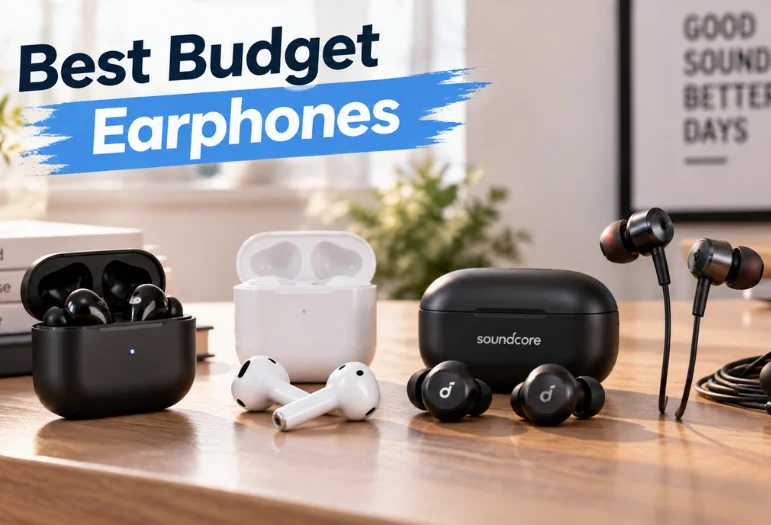
Finding the best budget earphones no longer means choosing between decent sound and useful features. In 2026, US buyers can find wireless models with active noise cancellation, multipoint Bluetooth, app-based EQ, and long battery life for less than $50, while wired earphones around $20 to $30 can deliver strong sound without charging or pairing.
The smartest choice depends less on the lowest price and more on whether you need wireless convenience, reliable calls, noise reduction, gaming performance, or simple plug-and-play listening.
Quick answer: The Soundcore P31i are our best overall budget earphones for most buyers because they combine adaptive ANC, multipoint connectivity, LDAC support, and up to 50 hours of rated total battery life for $49.99. For wired listening, the 7Hz x Crinacle Zero:2 offers excellent value around $25, while Sony’s IER-EX15C is a convenient USB-C choice.
Best Budget Earphones at a Glance
| Earphones | Type | Best for | Current US price* |
|---|---|---|---|
| Soundcore P31i | True wireless | Best overall | $49.99 |
| Sony WF-C510 | True wireless | Sound and comfort without ANC | $49.99 |
| JLab GO Pods ANC | True wireless | Best cheap ANC | $26.99 |
| 7Hz x Crinacle Zero:2 | Wired IEM | Best wired sound value | From $24.99 |
| Sony IER-EX15C | Wired USB-C | Best USB-C option | $29.99 |
| Apple EarPods USB-C | Wired USB-C | Calls and open fit | $19.99 |
| Sony MDR-EX15AP | Wired 3.5 mm | Lowest-cost everyday option | $12.99 |
*Prices were checked for the US market in September 2026 and can change with retailer promotions.
How We Chose These Budget Earphones
This guide focuses on products that offer a meaningful advantage at their price, not just a low sticker price. We compared current US pricing, manufacturer specifications, and independent testing or expert recommendations where available, with particular attention to sound, noise control, comfort, connection options, battery life, microphone usefulness, and overall value.
We also separated wired and wireless products because a $25 wired IEM and a $25 true-wireless pair solve very different problems. Techixia already has a dedicated comparison of affordable wireless models, so buyers who specifically want Bluetooth options can also read the best budget earbuds guide.
Readers who know they want a cable instead can go deeper with Techixia’s best wired earbuds guide. This broader guide is for shoppers still deciding between the two formats.
1. Soundcore P31i: Best Budget Earphones Overall
The Soundcore P31i sits in one of the most competitive price bands, yet its feature set goes well beyond basic wireless listening. Soundcore currently lists them at $49.99 with adaptive active noise cancellation rated for up to 52 dB of reduction in its controlled testing. The spec sheet also covers Bluetooth 6.1, LDAC support, 11 mm drivers, and up to 10 hours of listening per charge or 50 hours with the case when ANC is off.
RTINGS also places the P31i among its recommended budget, under-$50, noise-canceling, calling, and true-wireless models. That combination makes the P31i especially sensible for students, commuters, remote workers, and Android users who want more audio features without moving into premium pricing.
Their ANC is most useful against steady sounds such as engines, ventilation, and background hum, while the Soundcore app provides additional sound customization. Buyers should remember that manufacturer ANC figures reflect controlled conditions, so real-world performance depends on fit, ear-tip seal, and the type of surrounding noise.
Best for: Buyers who want the strongest balance of ANC, battery life, wireless features, and price.
Main drawback: The default tuning may be more bass-forward than listeners seeking a neutral presentation prefer.
2. Sony WF-C510: Best for Sound and Lightweight Everyday Listening
The Sony WF-C510 takes a simpler approach by leaving out active noise cancellation and concentrating on core everyday features. Sony specifies up to 11 hours of continuous music playback with Ambient Sound Mode switched off, Bluetooth 5.3, AAC and SBC codec support, multipoint connectivity, IPX4 water resistance, and a very light design of about 0.16 ounces per earbud. The model is currently listed at $49.99 through Sony’s US store, below its previous regular price.
These earphones make the most sense for listeners who spend much of their time in quieter environments and would rather prioritize comfort and straightforward sound over ANC. Multipoint is especially useful when switching between a laptop and phone, while Ambient Sound Mode lets you control how much of your surroundings you hear.
The main trade-off is obvious: commuters who regularly deal with trains, aircraft, or loud offices can get more effective noise control from similarly priced alternatives.
Best for: Music, podcasts, office use, and buyers who do not need active noise cancellation.
Main drawback: No ANC, despite competition offering the feature around the same price.
3. JLab GO Pods ANC: Best Budget ANC Earphones Under $30
Getting genuine hybrid active noise cancellation below $30 is still unusual enough to make the JLab GO Pods ANC stand out. A current Target listing puts them at $26.99, while JLab specifies hybrid ANC, Bluetooth multipoint, Google Fast Pair, IP55 protection, app-based controls, and up to 7.5 hours of listening from the earbuds or 26 hours total with ANC switched off.
With ANC enabled, JLab rates them at five hours per charge and 18 hours total, including the case. They are a practical choice for a gym bag, commute, backup pair, or first set of noise-canceling wireless earphones. The IP55 rating gives them better dust and splash protection than several inexpensive rivals, and multipoint makes them more useful for work than their price might suggest.
Their ANC and refinement will not match premium models, but the feature package is hard to dismiss at this price.
Best for: Shoppers with a strict $30 budget who still want ANC and multipoint Bluetooth.
Main drawback: Battery life drops noticeably when noise cancellation is active.
4. 7 Hz x Crinacle Zero:2: Best Budget Wired Earphones for Sound Quality
Wireless convenience is valuable, but spending the same money on wired earphones can direct more of the budget toward the drivers, housing, and cable instead of batteries and wireless electronics. The 7 Hz x Crinacle Zero:2 starts at $24.99 and uses a 10 mm dynamic driver with a detachable 0.78 mm two-pin cable; available versions also include 3.5 mm and USB-C connections.
Its published specifications list a 10 Hz to 20 kHz frequency range and 32-ohm impedance. The detachable cable is one of the strongest practical reasons to consider the Zero:2 because a damaged cable does not automatically mean replacing the entire earphone. Its tuning also gives budget-conscious music listeners a more audio-focused option than many ultra-cheap consumer earbuds.
There is no ANC, battery, companion app, or wireless convenience, so this is best viewed as a sound-first purchase rather than an all-purpose smart accessory.
Best for: Music listeners who want maximum wired sound value around $25.
Main drawback: A 3.5 mm version may require an adapter with modern phones, and it lacks wireless convenience.
5. Sony IER-EX15C: Best Budget USB-C Earphones
The Sony IER-EX15C are built for people who want wired earphones without carrying a 3.5 mm dongle. Sony’s current US product page lists them at $29.99 and describes direct USB-C connectivity for phones, computers, and compatible gaming devices, along with a compact design, microphone, controls, and tangle-resistant cable.
The official specification sheet also lists a roughly 3.94-foot cable, volume control, an omnidirectional microphone, and a weight of approximately three grams. Their biggest advantage is simplicity: no battery to recharge, Bluetooth menu to open, or pairing process to troubleshoot. That also eliminates the wireless latency and connection-drop concerns that matter to some gamers and video viewers.
USB-C audio support can vary by device, however, and Sony notes that certain phones may require USB-related settings to be enabled before audio works properly.
Best for: Android phones, USB-C iPhones, laptops, and buyers who want plug-and-play wired audio.
Main drawback: Check compatibility if your phone handles USB-C accessories unusually.
6. Apple EarPods USB-C: Best for Calls and Buyers Who Dislike Silicone Tips?
Apple’s USB-C EarPods remain one of the simplest inexpensive options for people who dislike the sealed feeling of silicone ear tips. Best Buy currently lists them at $19.99, while Apple describes built-in cable controls for volume, playback, and answering or ending calls. Their open-style shape lets more surrounding sound reach your ears, which can feel more natural in an office or at home but also reduces isolation in loud environments.
They are especially convenient for calls, meetings, voice notes, and casual listening because they require no charging or pairing. The design can also be more comfortable for users who find in-canal silicone tips irritating, although ear shape determines how securely EarPods stay in place. Bass impact and noise blocking are weaker than with properly sealed in-ear models, so frequent travelers and gym users may want something else.
Best for: Calls, office use, USB-C Apple devices, and listeners who prefer an open fit.
Main drawback: Limited passive isolation and less deep bass than sealed earphones.
7. Sony MDR-EX15AP: Best Ultra-Cheap 3.5 mm Earphones
For devices that still have a headphone jack, the Sony MDR-EX15AP shows that basic wired earphones can remain useful at a very low price. Sony currently lists the black model at $12.99 and includes a built-in microphone, a 3.5 mm four-pole connector, approximately a 1.2-meter cable, 9 mm dynamic drivers, and interchangeable silicone ear tips.
Their three-gram earbud weight also keeps them easy to carry as a spare pair for a laptop, controller, tablet, or older phone. You do not get detachable cables, premium materials, ANC, or sophisticated tuning, but that is not really the point at this price. They work well as an inexpensive backup, school pair, travel spare, or simple headset for devices with an analog jack.
Owners of newer smartphones will usually need a compatible USB-C-to-3.5 mm adapter, which can reduce the appeal compared with a direct USB-C model.
Best for: The lowest possible cost and devices with a standard headphone jack.
Main drawback: Basic construction and the need for an adapter on many modern phones.
Wired vs. Wireless: Which Budget Earphones Should You Buy?
Wireless models are usually the better option if you prioritize commuting, workouts, switching between devices, and keeping your phone in a pocket or bag without a cable. Spending around $30 to $50 now gets you features that previously belonged to more expensive products, including ANC, multipoint, configurable EQ, and useful charging-case battery life.
The trade-off is that batteries age, Bluetooth can introduce latency or connection problems, and the earphones eventually need charging. Wired models make more sense when reliable connection, low latency, long-term simplicity, and sound quality per dollar matter more than mobility. A good $20 to $30 IEM can avoid battery degradation entirely, and models with detachable cables can be repaired more economically when the cable fails.
Modern phones complicate things because you must choose the right USB-C model or use a compatible adapter. If you plan to connect wired audio hardware through your phone’s USB-C port, Techixia’s USB OTG guide explains why some USB accessories work immediately while others depend on device support or settings.
This matters especially with Android hardware because USB host and audio behavior can differ between phones. Checking compatibility before buying can save more frustration than comparing small differences in driver specifications.
How Much Should You Spend on Budget Earphones?
For wireless earphones, roughly $30 to $50 is currently the most attractive value zone for many US shoppers. That range can buy ANC, respectable battery life, app support, and multipoint connectivity, while moving closer to $100 usually improves refinement, microphone quality, noise cancellation, codecs, or charging features rather than transforming the basic listening experience.
Casual listeners in quiet places can spend less and still get a competent pair. For wired earphones, $20 to $30 can already buy a surprisingly capable IEM or USB-C model. Spending more may improve tuning, materials, isolation, driver technology, or cable quality, but you do not need a triple-digit budget for enjoyable music. A cheap wired backup can also make sense even if wireless earbuds remain your primary pair.
What to Check Before Buying Cheap Earphones
Fit and Ear-Tip Seal
Fit affects far more than comfort because an imperfect seal can reduce bass response and weaken passive isolation or ANC performance. Silicone-tip models typically include several sizes, and trying each size is worth the extra few minutes even when the medium tips seem acceptable. If you strongly dislike sealed ear canals, an open design such as EarPods may be more comfortable despite providing less isolation.
Active Noise Cancellation
ANC is most valuable when you regularly deal with low, steady background sounds such as buses, aircraft cabins, air conditioning, or road noise. Don’t compare manufacturer decibel ratings as if they were standardized real-world scores, because fit, measurement methods, and sound frequencies affect the result. Independent test results and ear-tip seal quality matter more than a single large number printed on a product page.
Battery Life
Wireless earphone battery claims usually quote two separate figures: playback from the earbuds themselves and total runtime after recharging them in the case. ANC, higher-quality Bluetooth codecs, phone calls, volume levels, and environmental conditions can all reduce the runtime you actually experience. Compare earbud runtime first if you need them to survive a workday or flight without returning to the case.
Connector Compatibility
A 3.5 mm plug remains ideal for older laptops, desktop PCs, audio players, some game controllers, and phones that retain a headphone jack. USB-C is more convenient for many current phones and computers, but support is not identical across every device and accessory combination. Checking your device’s port and digital-audio compatibility before ordering is more important than choosing between two otherwise similar wired models.
Final Verdict
The Soundcore P31i are the best budget earphones for most US buyers in 2026 because they deliver a strong combination of ANC, battery life, wireless features, and current $49.99 pricing. The JLab GO Pods ANC are the better choice when you need to spend under $30, while the Sony WF-C510 suits listeners who want a simple, lightweight wireless pair and don’t need ANC.
Wired buyers should start with the 7 Hz x Crinacle Zero:2 for sound-focused value, the Sony IER-EX15C for USB-C convenience, or the Apple EarPods when calls and an open fit matter most.
Frequently Asked Questions
What are the best budget earphones under $50?
The Soundcore P31i are our strongest all-around wireless choice under $50 because they combine adaptive ANC, multipoint connectivity, LDAC, and long-rated battery life. The 7Hz x Crinacle Zero:2 offers better value for listeners who prefer a wired, sound-focused IEM around $25. Buyers who want to spend as little as possible can also consider the JLab GO Pods ANC for wireless listening or the Sony MDR-EX15AP for a 3.5 mm wired connection.
Are cheap earphones worth buying in 2026?
Yes, especially if your expectations match the price category and your needs are straightforward. Budget wireless models can now include ANC, multipoint, long battery ratings, and app controls, while inexpensive wired IEMs can provide strong sound without batteries or Bluetooth. Premium earphones still tend to improve microphone performance, ANC consistency, materials, tuning refinement, and ecosystem features.
Are wired earphones better than cheap wireless earbuds?
Wired earphones usually offer a simpler connection, eliminate battery-life concerns, and can deliver excellent sound for relatively little money. Wireless earbuds are more convenient for commuting, exercise, calls, and switching between portable devices without managing a cable. Neither format is universally better, so the right choice depends on whether you value sound-per-dollar and reliability or wireless freedom and extra features.
Do I need ANC on budget earphones?
ANC is worthwhile if you frequently listen on public transportation, airplanes, busy streets, or in shared workspaces. It matters less in quiet bedrooms, home offices, and casual listening, where a properly sealed ear tip already blocks enough background sound. If you rarely encounter persistent noise, spending your budget on better sound, comfort, or battery life may provide more value.