

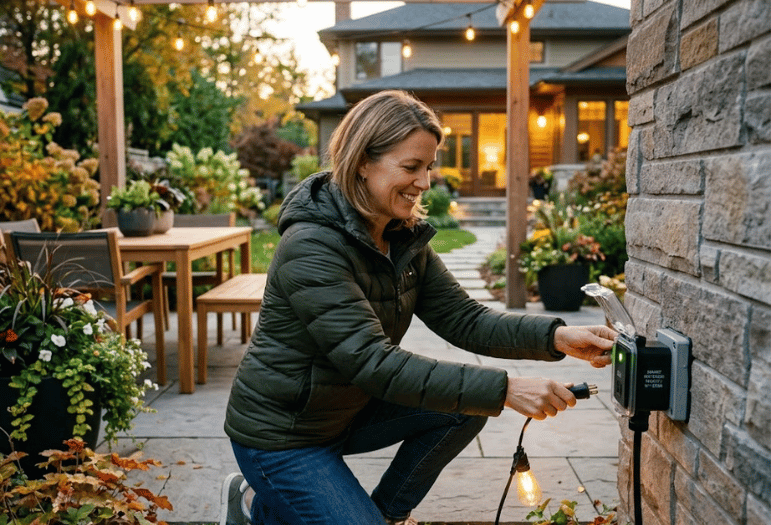
An outdoor smart plug gives ordinary patio lights, decorations, fountains, and compatible appliances remote control, schedules, and automation. For most homes, the right choice combines a strong weather rating, enough electrical capacity, reliable yard connectivity, and support for your preferred smart-home platform. Dual outlets can add useful flexibility. SN95 Mustang is a useful companion read here.
| What to check | Practical target |
| Weather protection | IP64 or IP65 is common among strong outdoor options |
| Connectivity | Reliable Wi-Fi or Matter support that fits your home |
| Electrical rating | Must meet the connected device’s load requirements |
| Outlets | One for simple setups; two for separate device control |
| Automation | Schedules, timers, routines, or sunrise/sunset control |
| Safety | Outdoor-rated equipment and installation that follows manufacturer instructions |
A connected outlet is most useful when the appliance already works whenever power reaches it. String lights, holiday decorations, fountains, and simple outdoor lighting are good examples. Devices that require someone to press another button after power returns may gain little from remote switching. Elsewhere on the site: Smart Mirror.
How to Choose an Outdoor Smart Plug
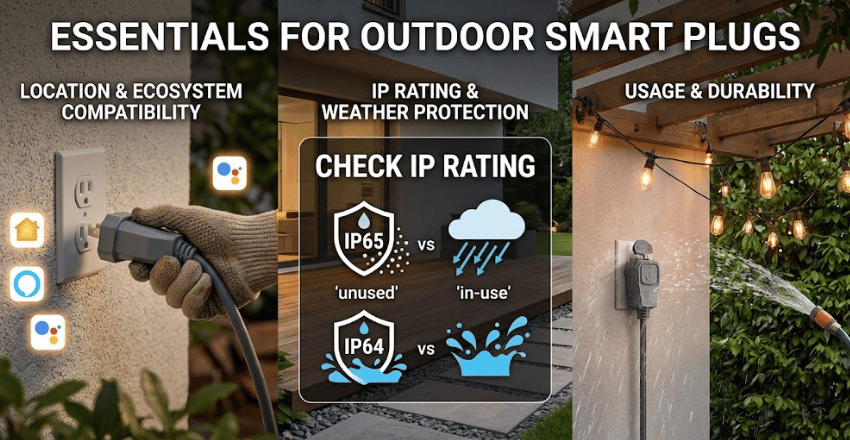
The product with the longest feature list isn’t automatically the right choice. Start with where it will live, what it will power, and which smart-home system you already use.
Check the IP Rating and In-Use Protection
Outdoor electronics need protection from dust and water. The two digits in an IP rating describe protection against solids and liquids.
For example, IP65 indicates dust-tight protection and resistance to water jets. It does not mean a device can be submerged. IP64 provides dust protection and resistance to splashing water.
Pay attention to the rating while something is connected. Covers often provide extra protection when an outlet is unused. Ring, for example, rates its outdoor model IP66 but IP64 while in use.
Match Connectivity to Your Existing Smart Home
Wi-Fi remains common because it can work without a separate automation hub. Many outdoor models use 2.4 GHz Wi-Fi because of its range characteristics.
Matter gives you another option. Compatible devices can work across ecosystems such as Apple Home, Google Home, Alexa, and SmartThings when the required controllers are available.
The Tapo P400M combines Matter with 2.4 GHz Wi-Fi. TP-Link states that its dual-antenna design can reach up to 300 feet in open conditions, although real range depends on walls and interference.
Matter over Thread is also appearing outdoors. IKEA’s TOFSMYGGA uses Matter over Thread and requires a Thread border router for phone control. Its availability and electrical format vary by region.
Check the Load Before Connecting Pumps or Appliances
A relay can only handle the electrical load specified by its manufacturer. Don’t assume every connected outlet can run every outdoor appliance.
The Tapo P400M is rated for up to 15A and 1,800W at 125V, including a stated 1/2-horsepower motor rating. Ring lists a 15A, 1,875W resistive maximum shared across its two outlets.
Check both the controller and the equipment you plan to connect. Motor loads deserve special attention because their requirements can differ from simple lighting.
Decide Whether You Need One Outlet or Two
Two independently controlled sockets can turn one physical receptacle into two automation zones. You could schedule patio lights separately from seasonal decorations, for example.
A single-output model may make more sense when you need a specialized function. The Kasa KP405 focuses on outdoor lighting and adds dimming rather than a second socket.
Four Strong Options for Different Outdoor Setups
| Model | Best fit | Key strengths | Main trade-off |
| Tapo P400M | Most general-purpose setups | Matter, IP65, two independent outputs, long-range Wi-Fi design | 2.4 GHz Wi-Fi only |
| Ring Outdoor Plug | Existing Ring homes | Two outlets, strong weather rating, Ring and Alexa integration | Bridge or compatible hub required for smart controls |
| Kasa KP405 | Dimmable outdoor lighting | IP64, app schedules, remote dimming, Alexa and Google support | One output and focused on compatible lighting |
| Leviton D215O | Broad platform support | Matter, IP65, light sensor, major smart-home ecosystems | One controlled load |
Tapo P400M: The Most Versatile Pick for Many Homes
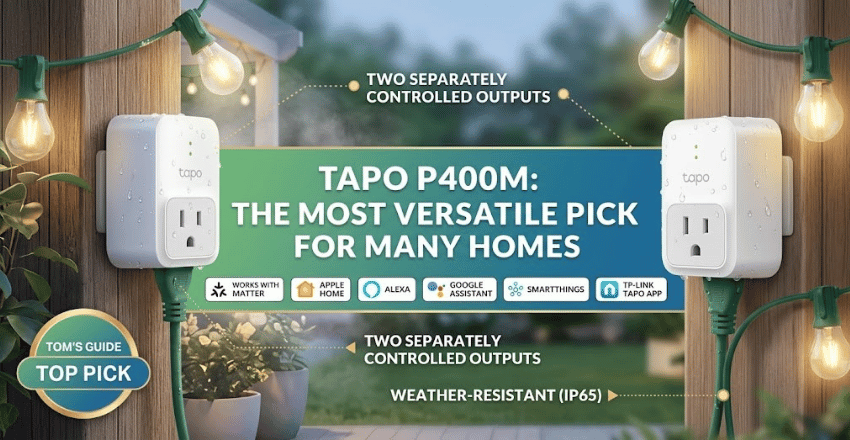
Our general recommendation is the Tapo P400M when you want two controllable outputs without locking the yard into one major ecosystem.
It supports Matter, Apple Home, Alexa, Google Assistant, and SmartThings. Its IP65 enclosure and two independent sockets also suit common patio and holiday-lighting jobs. Tom’s Guide selected it as its current top outdoor option after testing, which supports its position as a strong all-purpose choice.
Pros: wide platform support, two separately controlled outputs, scheduling, and substantial stated Wi-Fi range.
Cons: the wireless connection is 2.4 GHz Wi-Fi, so placement still matters when yard coverage is weak.
Ring Outdoor Plug: Best for a Ring-Centered Setup
Ring’s model makes the most sense if your outdoor lighting already belongs to a Ring and Alexa setup.
It offers independent control of two outputs and weather protection rated IP66, or IP64 while devices are connected. Ring requires a Bridge or another listed compatible hub for its smart controls.
Pros: strong integration with Ring lighting, dual control, schedules, and high weather resistance.
Cons: it’s less attractive for households that don’t already use the Ring ecosystem.
Kasa KP405: Best for Outdoor String-Light Dimming
The KP405 fills a more specialized role. It lets you change the brightness of supported outdoor lights rather than only switching them on and off.
TP-Link rates it IP64 and supports remote control, schedules, Alexa, and Google Assistant. The company states that it works with dimmable LED and incandescent lighting.
Pros: useful dimming control and simple app-based scheduling.
Cons: one output, with features aimed mainly at compatible lighting.
Leviton D215O: Best for Built-In Light-Based Automation
Leviton’s D215O supports Matter as well as Alexa, Google Home, Apple Home, SmartThings, and IFTTT. It also includes a light sensor that can control lighting based on ambient conditions.
That sensor is useful if you want outdoor lights to respond to darkness without relying only on a fixed clock schedule.
Pros: broad ecosystem support, IP65 protection, and a built-in light sensor.
Cons: it lacks the two separately controlled outputs found on Tapo and Ring models.
Outdoor Electrical Safety Matters More Than App Features
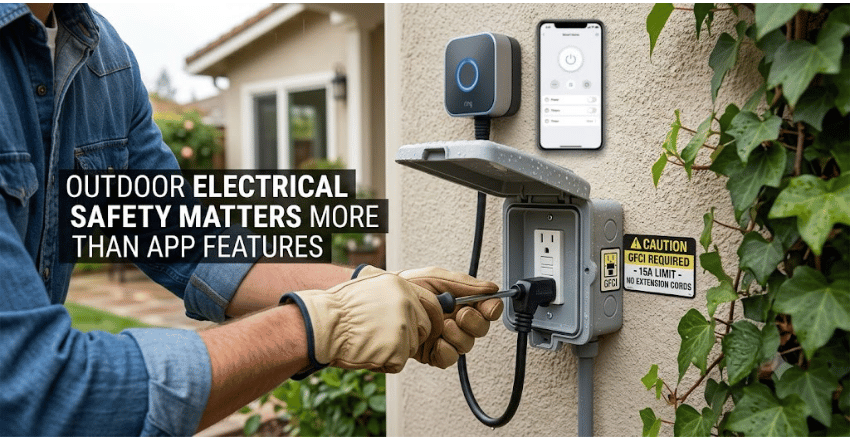
Weather resistance doesn’t replace safe installation. Follow the instructions supplied with the specific product and the equipment connected to it.
Ring’s safety guidance, for example, calls for outdoor use with a GFCI outlet, warns against exceeding the 15A device limit, and says not to connect its unit through an extension cord or relocatable power tap. Its installation instructions also specify the correct hanging orientation.
That illustrates a useful buying rule: read the installation requirements before choosing based on software features. A controller that doesn’t suit the outlet, load, or location is the wrong product even if its app looks ideal.
Conclusion
For most buyers, the Tapo P400M offers the strongest balance of weather resistance, dual control, platform compatibility, and yard-focused Wi-Fi design. Ring is the better fit for a Ring-centered home, while Kasa makes sense for dimmable lighting. Leviton stands out when light-sensor automation matters.
Choose based on weather exposure, electrical load, and ecosystem first. Once those three requirements match, Best Smart Thermostat for Home options become much easier to compare, and schedules and voice control become useful extras instead of reasons to compromise on the basics.
If you want to know about Best Mesh Router 2026 then visit our Smart Home category.
Frequently Asked Questions
A properly rated model can handle the weather conditions covered by its stated IP rating when installed as directed. Check the in-use rating too. Covers, orientation, outlet type, and manufacturer instructions can affect how the device should be installed.
No. Matter is useful when you want broader compatibility across smart-home platforms, but a conventional Wi-Fi model may work well if it already supports your chosen ecosystem. Matter also doesn’t solve weak wireless coverage by itself. A Wi-Fi Matter device still needs reliable Wi-Fi, while a Thread model needs a suitable Thread network and border router.
Yes, compatible holiday lights are one of the most common uses. Scheduling lets you switch displays on in the evening and off overnight without walking outside. Confirm that the lighting, extension equipment, receptacle, and controller are all suitable for the installation.
Not always. Remote switching and scheduling are common, but energy tracking varies by model and platform. If power monitoring matters, confirm exactly where the data appears before buying. Matter compatibility alone doesn’t guarantee that every ecosystem will expose every energy feature.