

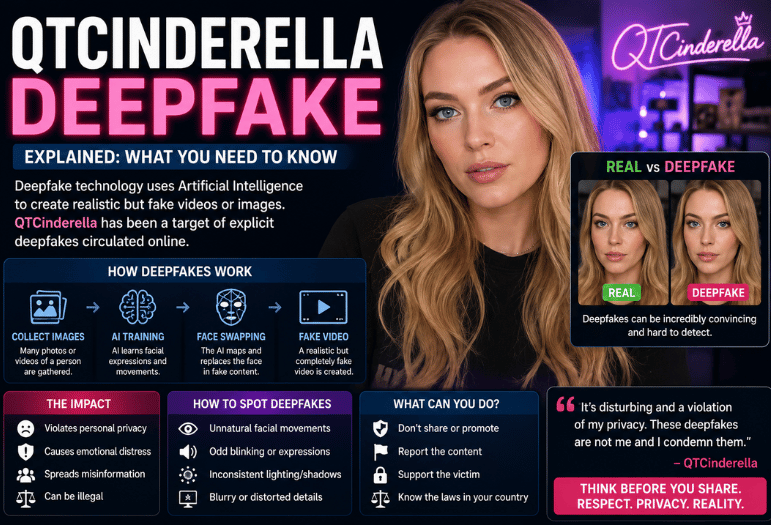
In January 2023, a Twitch streamer left the wrong browser tab open on a live broadcast. What that mistake exposed became one of the clearest public examples of image-based sexual abuse, and it changed how a lot of people understood the technology. This article covers what happened, the harm it caused, and what the law now says.
The QTCinderella deepfake incident began with streamer Atrioc, whose real name is Brandon Ewing. He was seen to have paid for AI-generated sexual images of female colleagues who had never consented. The images spread within hours. UK law has since criminalised both sharing and creating this material, though enforcement remains difficult.
The QTCinderella deepfake case in brief
| Detail | What is established |
| When | Late January 2023, during a live stream |
| How it surfaced | Open browser tabs visible on broadcast |
| Who was affected | Several female streamers, none of whom consented |
| The response | Public apologies on 30 January and 1 February 2023 |
| The source site | Taken down shortly afterwards |
| Legal options then | Minimal, per the lawyers she consulted |
| Sharing such images in the UK | Criminal since October 2023 |
| Creating such images in the UK | Criminal since February 2026 |
Key Takeaways
The victims did nothing and consented to nothing. The material was made and sold without their knowledge. And the law that would now cover it did not exist when it happened.
What happened?
During a broadcast, tabs on Atrioc’s screen showed he had paid for access to a site hosting AI-generated sexual imagery of women he knew professionally. Viewers captured screenshots and the story spread quickly across social platforms.
He apologised publicly twice within days and stepped back from streaming. The site hosting the material was taken offline soon after. By then the images had already been copied and redistributed by anonymous accounts, which is the part that could not be undone.
The harm, in her words

QTCinderella spoke publicly about the effect, and her account is worth taking seriously rather than summarising into abstraction. She described body dysmorphia, the return of an eating disorder, and trauma resurfacing from a childhood sexual assault. She said the violation carried “the same feeling”.
Two details are easy to overlook. Her family saw the images. And the harassment continued long after the source was removed, because removal at one site does nothing about the copies. This is the point most coverage of synthetic media misses. The technical question of how convincing a fake looks is far less important than the fact that a real person is on the receiving end of it.
Why there was almost no legal remedy in 2023
She consulted several lawyers and was told there was little to pursue. Some jurisdictions had begun passing laws, but action was expensive and uncertain. The main practical aim, removing the website, had already happened, which left little for a court to order.
That gap was the real story. Behaviour that everyone recognised as abusive sat outside the offences then on the statute book.
What UK law says now

| Conduct | Law | In force | Maximum sentence |
| Sharing or threatening to share intimate images without consent | Online Safety Act 2023, amending the Sexual Offences Act 2003 | October 2023 | Two years |
| Intentionally creating a sexual deepfake of an adult without consent | Data (Use and Access) Act 2025, adding section 66D | 6 February 2026 | Set by the new provisions |
| Requesting that such an image be created | Data (Use and Access) Act 2025 | 6 February 2026 | Set by the new provisions |
| Synthetic child sexual abuse material | Sexual Offences Act 2003 as amended | In force | Up to nine years |
The 2026 change matters because it closed the obvious loophole. Until then, making the material was not itself an offence for adult subjects, only passing it on. Proposals in the Crime and Policing Bill would go further and target the tools themselves, though that legislation has not completed its passage.
What can a victim do today?
- Record evidence first: screenshots, URLs, account names and timestamps, before anything is deleted
- Report to the platform under its intimate image policy, which every major service now operates
- Contact the Revenge Porn Helpline, which handles removal requests directly with platforms
- Use StopNCII.org, which creates a digital fingerprint of the image so partner platforms can block it without you uploading anything
- Report to the police, since sharing has been a criminal offence since 2023 and creation since 2026
- Ask search engines to remove the results, which is a separate process from removing the page
- Get support early, because the psychological effect is the part people consistently underestimate
Do not attempt to negotiate with whoever posted it. Evidence preservation and formal reporting achieve more, and contact tends to invite further harassment.
Spotting synthetic media

- Check the source first, since provenance beats visual inspection every time
- Look at edges where hair meets background, a common failure point
- Watch for lighting that does not match between face and body
- Note irregular blinking or unnatural mouth movement in video
- Be sceptical of anything that surfaces without an original poster or date
These heuristics are weakening as tools improve. Verification through the source is the only approach that holds up, and the tools that generate this material keep advancing, as our overview of unrestricted AI image generators makes clear.
Why does this case still matter?
QTCinderella Deepfake It moved a harm that was easy to dismiss as hypothetical into plain view, with a named victim describing the cost. The law that followed was slow, arriving three years after the incident, but it did arrive.
If you take one thing from this, make it the removal routes above. They work better when used quickly, and knowing they exist before you need them is the practical difference. For related reading, see our guides to protecting your devices and securing your home network.
Want to know about Best AI Photo Editor, Check out our AI Tools category.
Frequently asked questions
The exposure, during a January 2023 live stream, that a streamer had paid for AI-generated sexual images of female colleagues who never consented. The images then spread online.
No prosecution followed. The relevant offences either did not exist or did not apply at the time, which is precisely why the law was later changed.
Yes. Sharing became an offence in October 2023 and intentionally creating it became an offence on 6 February 2026, along with requesting its creation.
Rarely. Taking down the source stops distribution at that point, but copies persist. Fingerprinting services block re-uploads on participating platforms, which limits spread rather than erasing it.
The Revenge Porn Helpline supports adults in the UK, and StopNCII.org works internationally. Both are free, and neither requires you to send the image itself.