

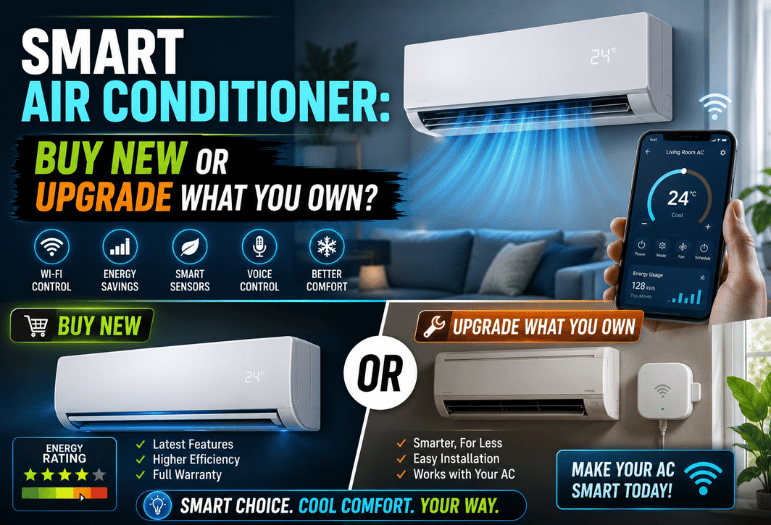
Your bedroom hits 84 degrees by four in the afternoon, and nobody is home to flip a switch. Two products solve that. One is a new inverter window unit with Wi-Fi built in. The other is a small puck that fires infrared at the AC already sitting in your window, and it costs a third as much.
The short version: buy a smart air conditioner when your current unit is loud, badly sized, or past about eight years old. Otherwise keep the box you own and add a controller for roughly $139. Both routes give you scheduling, phone control, and voice commands. Only the new unit also cuts what you pay the utility.
The two routes at a glance
| Route | What you spend | Best for | The catch |
| Smart window or portable unit | $279 to $449 | Old, loud, or wrongly sized cooling | Install day, and a very heavy box |
| Smart mini split | $1,959 and up | A room you cool every single summer | Permanent, and usually an electrician |
| Smart AC controller | $70 to $139 | Any AC that takes an infrared remote | It cannot make an inefficient unit efficient |
| Smart plug | $10 to $25 | Almost nothing on this list | Motor rating too low, and no auto restart |
Key takeaways
- A controller costs about a third of a new unit and installs in five minutes.
- Federal efficiency rules for room units tightened on May 26, 2026.
- Size by room area first, brand second. Oversizing leaves the room clammy.
- Matter certification on window units is rare, so check before you assume.
- Running an 8,000 BTU unit eight hours a day costs roughly $22 to $28 a month.
What “smart” actually buys you
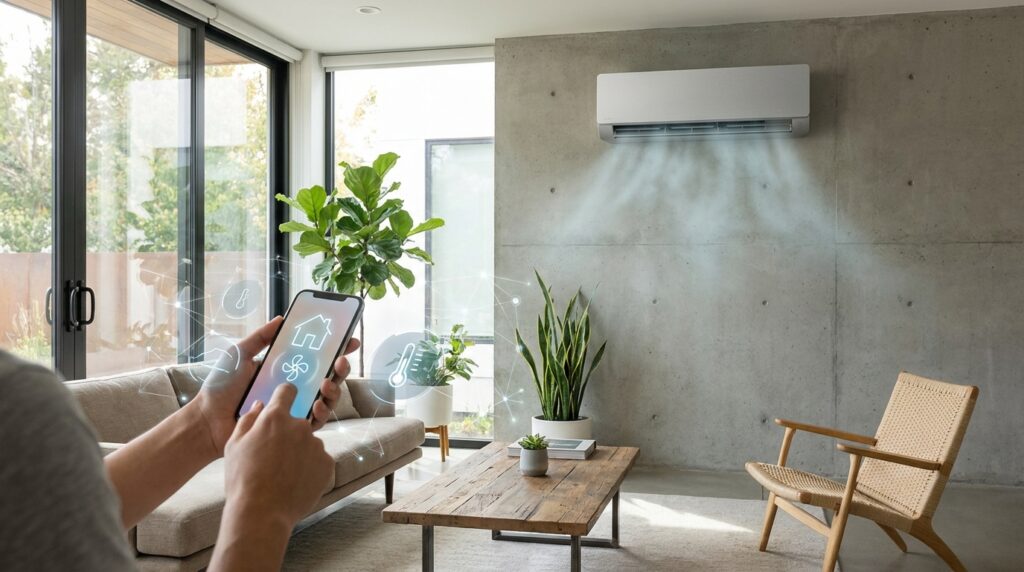
Strip away the marketing, and connected cooling does four useful things. It starts the room cooling before you walk in. Nobody has to remember to shut it off when the apartment empties. You can fix a forgotten setting from the office. And the app reports what the unit is drawing, so a surprise bill has an explanation.
What it doesn’t do is change physics.
A connected compressor still moves the same heat as an unconnected one. Savings come from runtime you avoid, not from the app itself. That is the same logic behind whole-home climate control, and our smart thermostat picks for home HVAC cover the ducted version of the same argument.
Route one: buying a smart air conditioner
Replacement makes sense on a short list of triggers. Maybe it is louder than it was. It runs constantly and the room never gets comfortable. It has no remote at all, so no controller can copy its signals. Or it predates the current efficiency floor by a decade.
Window and portable units worth the money
| Model | Capacity | US price | Platforms | Why it stands out |
| Midea U+ MAW08U1QWT | 8,000 BTU, 350 sq ft | $379, Home Depot | Alexa, Google, Matter | The window still opens above it |
| LG LW8022IVSM Dual Inverter | 8,000 BTU, 350 sq ft | $449, Home Depot | ThinQ, Alexa, Google | 44 dB, and a mature app |
| GE Profile ClearView AHTT08BC | 8,300 BTU, 350 sq ft | $429, GE Appliances | SmartHQ, Alexa, Google, Matter | You can see through the window |
| MRCOOL DIY 5th Gen | 12,000 BTU, 23.5 SEER2 | $1,959, Home Depot | App, Alexa, Google | Heats in winter as well |
Pros: lower running cost, quieter inverter compressors, real energy reporting, and a warranty that starts today. Cons: a 60-pound box to lift, a window you lose for the season, and $300 or more gone before the first cold air arrives.
When a mini split is the better call
Mini splits stop making sense as a gadget purchase and start making sense as a building decision. You are cutting a hole, mounting an outdoor condenser, and probably calling an electrician. In exchange, you get quiet, efficiency in the low twenties on the SEER2 scale, and heat in January. Rent an apartment, and this isn’t your purchase. Own the house and cool the same room every year, and it usually is.
Route two: a controller for the AC you already own
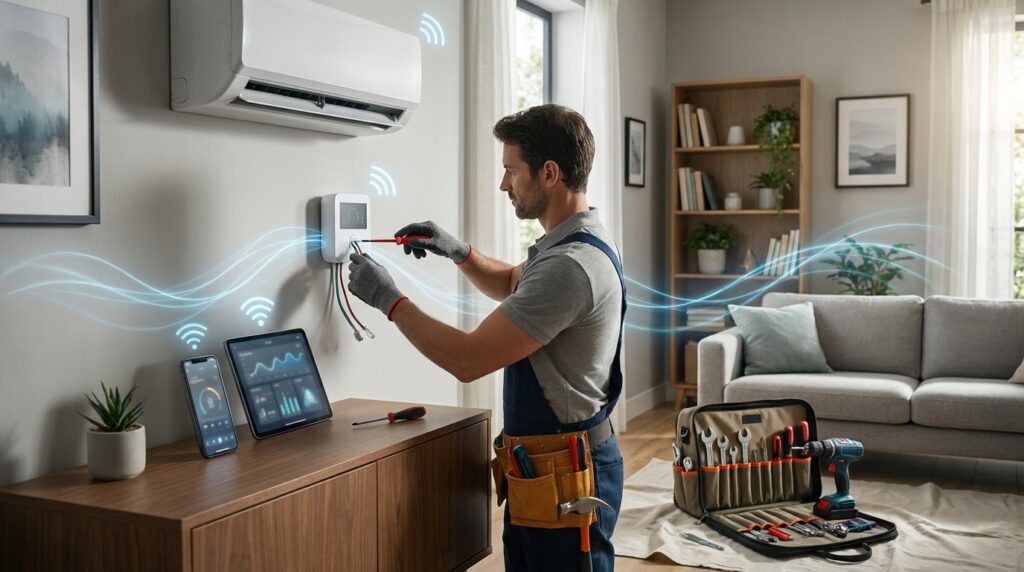
A smart AC controller learns your remote’s infrared codes and then pretends to be that remote. It also holds a temperature sensor, which is the part that matters. Your window unit measures air at the grille, inches from its own cold coil. A controller across the room measures where you sleep.
| Device | Price | Works with | Watch out for |
| Sensibo Air Pro | $139, list $215 | Alexa, Google, Siri and HomeKit, SmartThings, IFTTT | Air quality sensor is the reason for the premium |
| Cielo Breez Max | Retail varies | Alexa, Google, Siri Shortcuts, SmartThings, Home Assistant | No Matter, and the older Breez Plus is discontinued |
| SwitchBot Hub 2 | $69.99 | Alexa, Google, Apple Home | Cheapest route, though Matter covers only some devices |
| Tado Smart AC Control | No US storefront | Alexa, Google, Siri | Roundups still list it; American buyers cannot easily get it |
Two warnings before you buy one. Any controller needs line of sight to the unit’s receiver, so a bookshelf in between will break it. And nearly all of these devices are 2.4 GHz only, which is exactly the band that struggles at the far end of a house. If that describes your back bedroom, mesh router systems that kill dead zones solve the problem more reliably than moving the puck around.
Pros: $139 instead of $429, five-minute setup, and it works on mini splits and portables too. Cons: your old unit still draws exactly what it drew before.
Why a smart plug is usually the wrong answer
This is the shortcut everyone tries first, and it fails for two separate reasons.
Start with the electrical side. A Kasa EP25 is rated for 15 amps and 1,800 watts, which sounds like plenty, until you read the motor rating printed alongside it: one-sixth of a horsepower. A window compressor is several times that. Load ratings are the whole story with switched outlets, and the same math shows up in what an outdoor smart plug can safely switch.
Behavior is the second problem. Cutting power to a modern AC doesn’t turn it off politely. Most digital units come back to standby rather than to cooling, so your 3 p.m. schedule fires and nothing happens. Only an old mechanical dial unit reliably restarts, and those are the ones the efficiency rules are steadily retiring.
Getting the BTU size right
Capacity is where most buyers guess, and guessing high feels safe. It isn’t. The Department of Energy’s Energy Saver guidance is blunt about the rule: you need 20 BTU for each square foot of living space. That puts a 350-square-foot bedroom at 7,000 BTU. DOE also warns that an oversized unit cools a room too quickly to dehumidify it properly. Short cycling is why a chilly room can still feel swampy.
| Room size | Roughly what you need | Typical unit |
| 150 sq ft | 3,000 BTU | Smallest units start near 5,000 |
| 250 sq ft | 5,000 BTU | 5,000 to 6,000 BTU |
| 350 sq ft | 7,000 BTU | 8,000 BTU class |
| 450 sq ft | 9,000 BTU | 10,000 BTU class |
| 700 sq ft | 14,000 BTU | Mini split territory |
Adjust up for a west-facing wall of glass, a top floor, or a kitchen. Adjust down for heavy shade. Portable units deserve extra suspicion here, because the number on the box is often the older peak rating rather than the seasonally adjusted figure the label now carries.
CEER, SEER2, and the rule that changed in May
Room units are graded on CEER, which folds standby draw into the efficiency number. Ducted and ductless systems use SEER2, measured under a tougher airflow test, so those figures read a little lower than the old SEER numbers for identical hardware.
The floor moved this year. According to the Department of Energy’s final rule in the Federal Register, compliance with the amended standards for room air conditioners is required on and after May 26, 2026. Amended levels run from 12.8 to 16.0 Btu/Wh CEER across sixteen equipment classes. DOE also puts the average life of one of these units at 9.3 years, which is a fair way to judge the box in your window right now.
What it costs to run each month
Divide the rated BTU by the CEER, and you get watts. From there, the arithmetic is easy. The Energy Information Administration reported an annual average residential electricity price of 17.30 cents per kWh for 2025. Everything below uses that rate, at eight hours of runtime a day for thirty days.
| Rated cooling | Older unit near CEER 12 | Inverter unit near CEER 15 |
| 8,000 BTU | 667 watts, about $28 | 533 watts, about $22 |
| 12,000 BTU | 1,000 watts, about $42 | 800 watts, about $33 |
So the efficiency upgrade is worth six to nine dollars a month of cooling season. Over a four-month summer, that is $24 to $36. A $379 replacement does not pay for itself on power savings alone, which is the honest reason to keep a healthy unit and spend $139 on control instead.
Alexa, Google Home, HomeKit and Matter

Voice support is close to universal now. Matter is not. Midea’s U series was the first Matter-certified window unit sold in the United States, announced in August 2023, and GE’s Profile ClearView line lists Matter too. Most other window units stop at Alexa and Google through the maker’s own app. Among controllers, Sensibo is the one that covers Apple HomeKit natively, which matters if your household runs on iPhones.
All of it depends on the signal reaching the window, and window units sit in exterior walls by definition. If your app keeps showing the unit as offline, work through the steps that improve a weak WiFi signal before you blame the appliance.
Which route should you pick?
Our recommendation for most readers is the controller. Buy the Sensibo Air Pro at $139 if you want HomeKit and air quality data. Buy the SwitchBot Hub 2 at $69.99 if you want the cheapest thing that works. Keep the AC you own until it genuinely fails.
Buy new when the unit is over nine years old, obviously the wrong size, or so loud you avoid using it. Midea’s U+ at $379 is the pick there, because it is quiet, Matter certified, and leaves the window usable.
Do this next: measure your room, read the capacity and the CEER off your current unit’s label, and check whether its remote is infrared. Those three numbers decide the whole purchase in about five minutes.
Frequently asked questions
It is worth it when the unit it replaces is old, loud, or the wrong size for the room. If your current AC still cools well, a $139 controller delivers the same app control and schedules for far less money.
Yes, as long as it has an infrared remote. A controller learns those codes and takes over, adding schedules, geofencing, and a temperature sensor placed where you actually sit.
Start at 20 BTU per square foot, so about 7,000 BTU for a 350-square-foot room. Add capacity for strong sun or a top floor, and subtract for deep shade.
The cooling does. Schedules stored on the device usually keep running, but voice commands, remote access, and energy reporting stop until the connection returns.
It is cooling output divided by total power draw, standby included. Higher is better, and since May 26, 2026, new room units sold in the US have to sit between 12.8 and 16.0 Btu/Wh depending on their class.