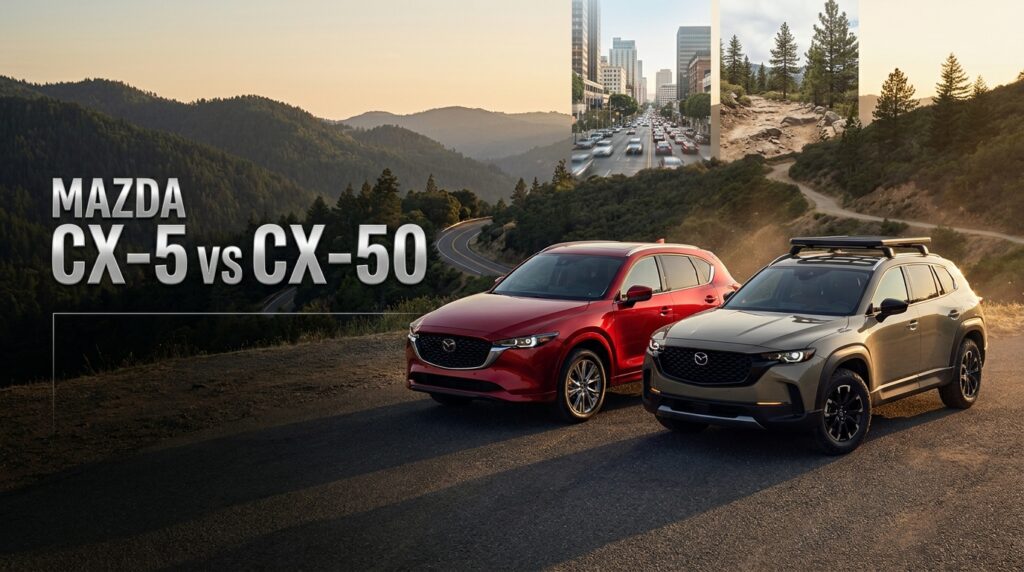

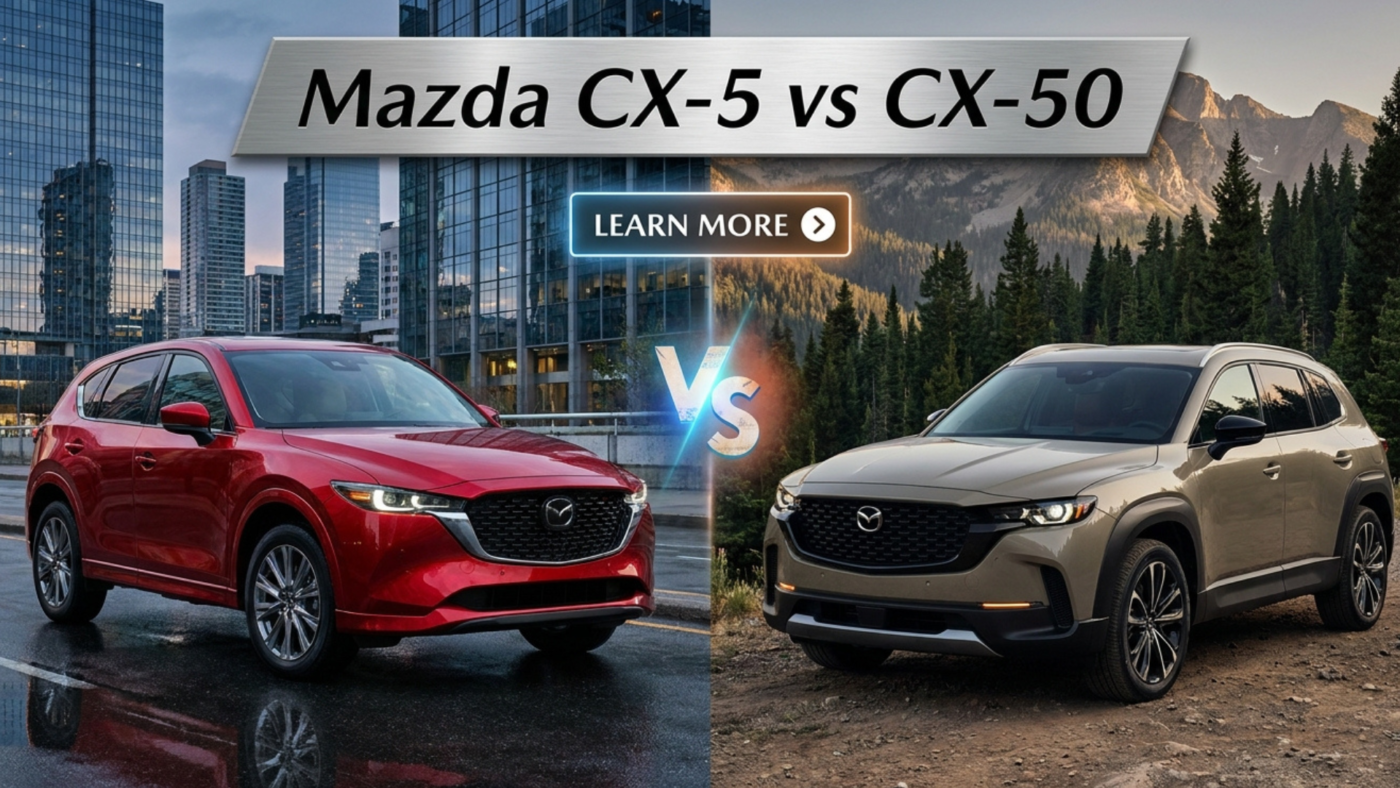
Choosing between Mazda’s two compact crossovers is harder than their names suggest. In a CX-5 vs CX-50 comparison, the redesigned 2026 CX-5 is the stronger choice for most families and daily commuters. The CX-50 makes more sense for buyers who want turbo power, greater towing capacity, hybrid efficiency, or a more outdoors-focused design.
Both models start near $30,000, come with all-wheel drive, and use a standard 187-horsepower engine. Their priorities are different, though. The CX-5 favors passenger comfort, cargo capacity, and newer cabin technology. The CX-50 offers more powertrain choices and added capability for active lifestyles.
| Category | 2026 Mazda CX-5 | 2026 Mazda CX-50 |
| Starting MSRP | $29,990 | $29,900 |
| Standard engine | 2.5-liter four-cylinder | 2.5-liter four-cylinder |
| Standard output | 187 hp | 187 hp |
| Optional powertrains | None for 2026 | Turbo and hybrid |
| Combined fuel economy | 26 mpg | Up to 38 mpg with hybrid |
| Maximum towing capacity | 1,500 pounds | Up to 3,500 pounds |
| Maximum cargo capacity | 66.5 cubic feet | 56.3 cubic feet |
| Best suited for | Families and daily driving | Outdoor use, towing and powertrain choice |
Prices exclude destination charges, taxes, registration costs, and dealer-added fees. Equipment can also change by trim. Mazda’s official comparison lists the CX-5 at $29,990 and the CX-50 at $29,900 before those extra costs.
The Short Verdict
Choose the CX-5 for family space, a quieter road-focused character, newer infotainment, and greater maximum cargo capacity. Choose the CX-50 if you need stronger acceleration, a 3,500-pound towing limit, a fuel-saving hybrid, or a lower and more rugged body. For most everyday buyers, the CX-5 is the better all-rounder.
CX-5 vs CX-50 Size and Passenger Space
Mazda redesigned the CX-5 for 2026 and made it much larger than the previous generation. It now measures 184.6 inches long and rides on a 110.8-inch wheelbase. The CX-50 is slightly longer, but both vehicles now share the same wheelbase.
The CX-5 has the taller and more upright shape. Its official height is about 66.7 inches, compared with roughly 63.5 to 63.9 inches for the gas CX-50. That difference gives the CX-5 a more conventional SUV profile and may make its cabin feel airier.
The CX-50 is lower and wider in appearance. Its stance looks sportier, but the lower roof can affect how easily taller passengers enter or leave the rear seats. The CX-5 also has larger rear-door openings, which can help when installing a child seat. Mazda says the redesign increased rear-seat space and made the cargo area more useful.
Which One Has More Cargo Space?
The CX-5 provides the larger maximum cargo area. Mazda lists 33.7 cubic feet behind its rear seats and 66.5 cubic feet when those seats are folded.
The CX-50 provides 31.4 cubic feet behind the second row and 56.3 cubic feet with the seats down. Its cargo floor is long and relatively flat, which is useful for outdoor equipment. Still, the CX-5 offers about 10 cubic feet more total capacity when you need to carry bulky items.
Cargo winner: CX-5.
Performance and Driving Experience
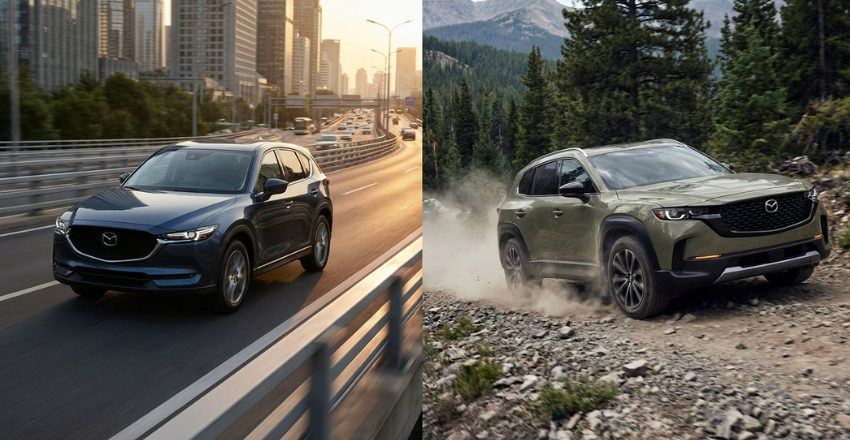
The standard versions are closely matched. Both use a naturally aspirated 2.5-liter four-cylinder engine producing 187 horsepower. Both also pair that engine with a six-speed automatic transmission and all-wheel drive.
The CX-5 is aimed at drivers who value smooth daily performance. Its suspension and taller body suit commuting, school runs, and highway travel. The redesigned model is less focused on sharp handling than its predecessor, according to recent comparison testing, but it remains composed and easy to drive.
The CX-50 provides more choice. Its available turbocharged engine produces up to 256 horsepower and 320 pound-feet of torque when using the recommended premium fuel. That makes it the clear option for stronger acceleration.
It also includes driving modes intended for different conditions. Gas versions offer Sport and Off-Road modes, while properly equipped turbo models add a towing mode.
Performance winner: CX-50, especially with the turbo engine.
Fuel Economy and Hybrid Availability
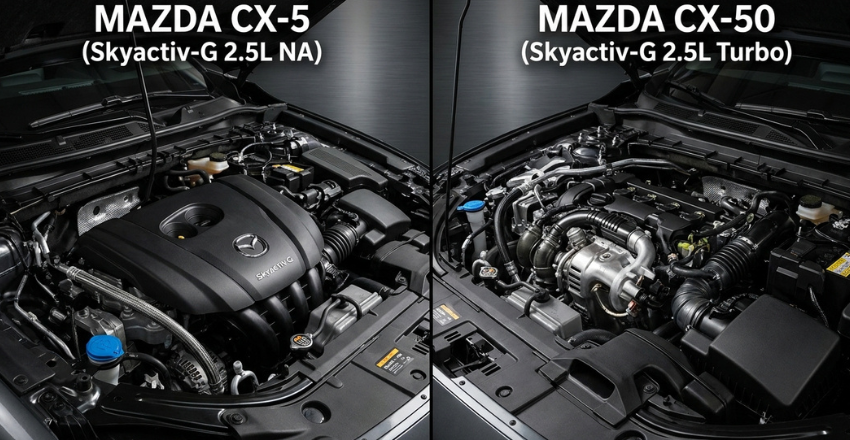
Standard gas-powered versions of both crossovers have similar EPA estimates. Mazda lists the CX-5 at 24 mpg in the city, 30 mpg on the highway, and 26 mpg combined.
The naturally aspirated CX-50 also earns estimates of 24 mpg city, 30 mpg highway, and 26 mpg combined. Turbo versions fall slightly to 23 mpg city, 29 mpg highway, and 25 mpg combined.
The biggest distinction is the CX-50 Hybrid. Its gas-electric system produces 219 horsepower and earns an estimated 39 mpg city, 37 mpg highway, and 38 mpg combined. It costs more upfront, starting at $34,750, but it could reduce fuel use for drivers with long commutes.
Mazda has announced a hybrid CX-5 for a later model year, but the 2026 version launches only with the standard gas engine. Buyers shopping now must choose the CX-50 to get a Mazda compact crossover with hybrid power.
Fuel-economy winner: CX-50 Hybrid.
For more automotive and technology coverage, visit the Techixia technology section. You can also read about Techixia or contact the editorial team to suggest topics.
Towing and Outdoor Capability
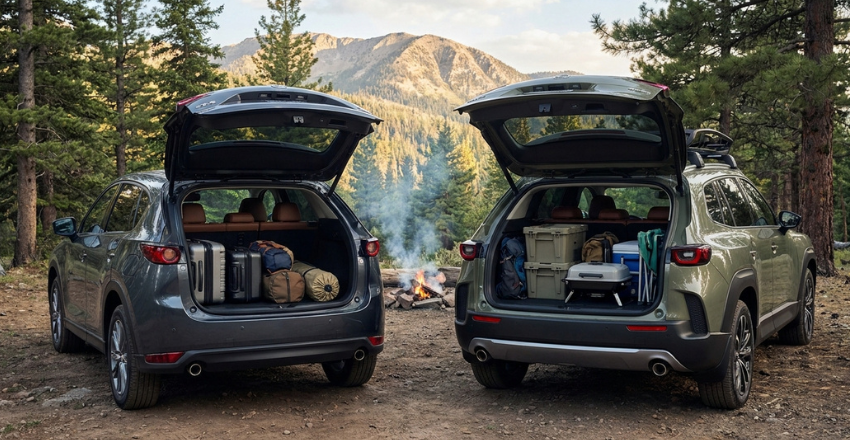
The CX-50 is the better towing vehicle. Standard 2.5 S versions can tow up to 2,000 pounds when properly equipped. Turbo models raise that limit to 3,500 pounds. The CX-5 is rated to tow up to 1,500 pounds. That can handle a small utility trailer, but it offers less flexibility for boats, campers, or heavier recreational equipment.
Ground clearance also favors the adventure-themed model. Depending on configuration, the CX-50 provides up to 8.6 inches. The CX-5 offers between 8.0 and 8.2 inches.
Neither crossover is designed as a hard-core off-roader. Still, the CX-50’s extra clearance, flatter cargo floor, roof-friendly profile, and dedicated Off-Road mode make it better suited to campsites and rough access roads.
Capability winner: CX-50.
Interior Technology and Controls
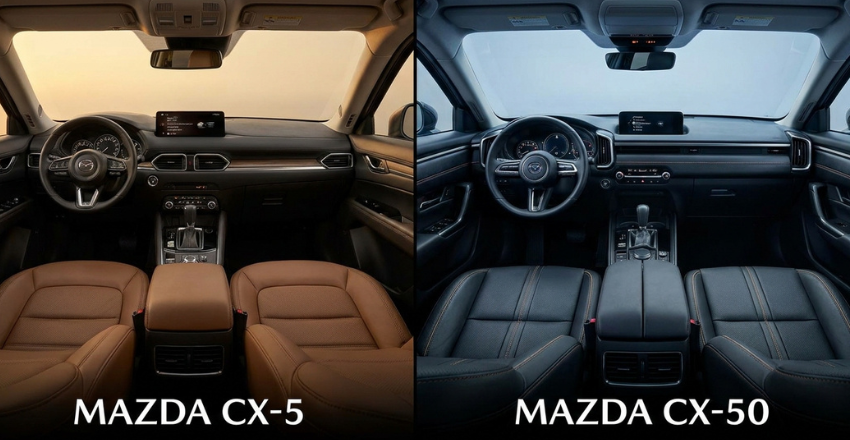
The redesigned CX-5 receives Mazda’s newest cabin technology. Depending on trim, it offers a 12.9-inch or 15.6-inch touchscreen with Google built-in. Its available features include Google Maps, voice controls, and connected applications.
The CX-50 uses a 10.25-inch display. It supports wireless Apple CarPlay and Android Auto, Alexa Built-in, Bluetooth, and physical console controls. Some drivers may prefer its mix of buttons and a rotary controller over the CX-5’s more screen-centered layout.
The right choice comes down to preference:
Technology winner: CX-5 for screen size and software; CX-50 for physical controls.
CX-5 Pros and Cons
Pros
- Comfortable, quiet ride that is ideal for daily commuting.
- Premium interior with high-quality materials and refined styling.
- Responsive handling that feels more like a sporty sedan than a typical SUV.
- Available turbocharged engine delivers strong acceleration.
- Excellent safety ratings and a wide range of driver-assistance features.
- Compact size makes parking and city driving easier.
- Good fuel economy, especially with the standard engine.
- Strong reliability record and lower long-term ownership costs.
Cons
- Less rear-seat legroom than some competitors.
- Cargo space is smaller than the CX-50.
- Standard infotainment system can take time to learn.
- Limited off-road capability compared with the CX-50.
- Rear visibility is slightly restricted due to the vehicle’s design.
- No hybrid option in many markets.
CX-50 Pros and Cons
Pros
- Rugged styling with a wider, more aggressive stance.
- Better ground clearance for light off-road adventures.
- Larger cargo area with a practical, adventure-focused layout.
- Standard all-wheel drive on most models.
- Strong towing capability, especially with the turbo engine.
- Available panoramic moonroof enhances cabin openness.
- Excellent handling while remaining comfortable on highways.
- Durable interior materials designed for active lifestyles.
Cons
- Rugged suspension setup may not appeal to buyers seeking maximum comfort.
- Ride quality is firmer than the CX-5, especially on rough roads.
- Rear seat can feel tighter because of the lower roofline.
- Higher price compared with a similarly equipped CX-5.
- More road noise on certain pavement surfaces.
- Fuel economy may be lower with the turbocharged engine.
Which Mazda SUV Should You Buy?
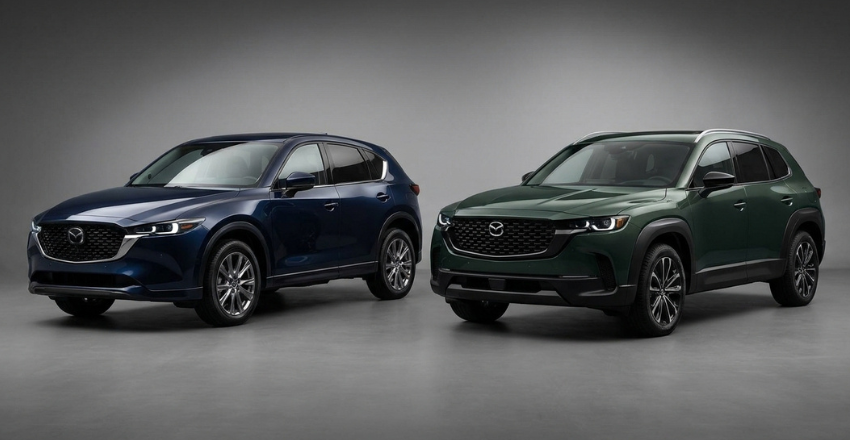
The CX-5 vs CX-50 decision becomes easier when you focus on what you’ll do most often. Choose the CX-5 when your routine includes commuting, carrying passengers, installing child seats, or loading large household items. Its extra interior capacity and new cabin technology make it a practical daily vehicle.
Choose the CX-50 when weekend needs matter as much as weekday driving. Its turbo engine, hybrid option, extra ground clearance, and greater towing ability provide capabilities the CX-5 doesn’t offer in 2026.
Our Recommendation
The CX-5 is our pick for most shoppers. It gives families more usable space without a meaningful increase in starting price. Its standard engine is adequate for daily travel, and its redesigned cabin feels more current. The CX-50 remains the better specialist. Buy it when you can name the feature you need, such as turbo power, hybrid fuel economy, extra clearance, or a 3,500-pound tow rating.
Before deciding, test-drive comparable trims on the same day. Check rear-seat access, measure the cargo area for your gear, and compare the final dealer prices rather than relying only on base MSRP.
Final Take
Buy the CX-5 for daily comfort, newer technology, and more total cargo space. Buy the CX-50 for towing, stronger performance, hybrid efficiency, or frequent outdoor travel. Both begin at nearly the same price, so the decision shouldn’t rest on the base MSRP alone. Compare the trims that contain your required features, then choose the vehicle whose strengths match how you’ll use it.
Frequently Asked Questions
The CX-50 is slightly longer, but the CX-5 is taller and offers greater maximum cargo volume. Both 2026 models have a 110.8-inch wheelbase.
The CX-5 is usually better for families because it offers a taller cabin, larger rear door openings, and more cargo space with the rear seats folded.
Both models offer all-wheel drive. Tires have a major effect on winter traction, so neither model has an automatic advantage in every snowy situation. The CX-50 does offer slightly more ground clearance.
The turbocharged CX-50 is much quicker than either crossover with the standard 187-horsepower engine. Mazda does not offer a turbocharged 2026 CX-5.
Their standard gas engines return similar estimates. The CX-50 Hybrid is the efficiency leader at an estimated 38 mpg combined.
The CX-5 focuses on family comfort, space, and road use. The CX-50 focuses on powertrain choice, towing, ground clearance, and outdoor versatility.