


The Python exponent operator is one of the most commonly used features in Python programming, allowing you to raise numbers to powers with simple and efficient syntax. Whether you’re building mathematical applications, analyzing data, creating machine learning models, or solving everyday programming problems, understanding how Python handles exponents is essential. Our related guide, Checklist Template, goes further into this.
Python provides multiple ways to perform exponentiation, including the operator, the built-in pow() function, and the math module for specialized calculations. Knowing when to use each method helps you write cleaner, more accurate, and more efficient code while avoiding common mistakes such as confusing the ^ operator with exponentiation.
| Python exponent | Recommended approach | Example | Result |
| Raise a number to a power. | ** | 2 ** 5 | 32 |
| Use function syntax. | pow() | pow(2, 5) | 32 |
| Calculate a modular power. | pow(base, exp, mod) | pow(3, 4, 5) | 1 |
| Find a square root with a power | ** 0.5 | 81 **0.5 | 9.0 |
| Calculate e raised to x. | math.exp() | math.exp(2) | about 7.389 |
Key takeaways: Use ** for most powers. Use pow() when function syntax or modular arithmetic is useful. Don’t use ^ as a power symbol. Add parentheses when a negative base must be raised to a power.
How the Python Exponent Operator Works
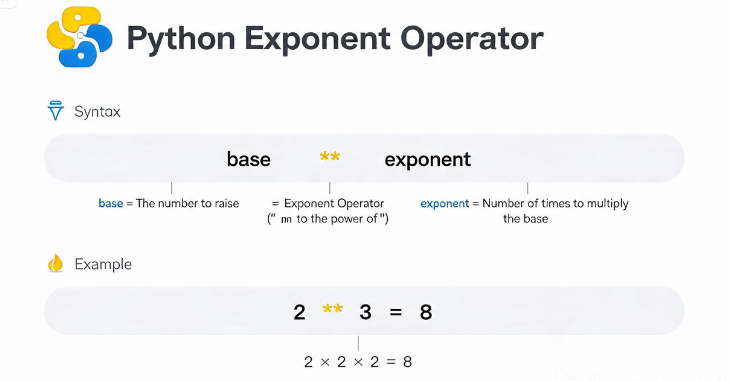
Python uses two asterisks for exponentiation:
square = 7 ** 2
cube = 3 ** 3
print(square) # 49
print(cube) # 27
The value on the left is the base. The value on the right specifies the exponent. Python defines the two-argument power operator with the same semantics as the built-in pow() function. Numeric operands are converted according to Python’s normal arithmetic rules.
You can also use negative and fractional powers:
print(2 ** -3) # 0.125
print(81 ** 0.5) # 9.0
A negative exponent produces a reciprocal. An exponent of 0.5 represents a square root for a positive number.
Why Does It Not Calculate Powers?
Programmers who are used to calculators or other forms of notation may try this:
2 ^ 3
That expression does not mean two cubed. Python uses ^ for the bitwise XOR operation. Use this instead:
2 ** 3
The standard operator module maps a ^ b to XOR and a ** b to exponentiation. This distinction prevents a subtle class of bugs. Code containing ^ may still run when both operands are integers, but the result can be mathematically incorrect.
Choosing Between **, pow(), and math. Pow ()
The three common approaches overlap, but they are not interchangeable in every situation.
| Method | Best use | Main behavior |
| base **power** | Normal calculations | Concise and supports Python numeric types |
| pow(base, power) | Function-based calculations | Equivalent to two-argument ** |
| pow(base, power, mod) | Modular arithmetic | Computes the power modulo a number efficiently |
| math.pow(x, y) | Float-based mathematical work | Converts both arguments to float |
| math.exp(x) | Natural exponential functions | Calculates e raised to x |
For ordinary code, ** is easy to read:
area_scale = 4 ** 2
The built-in pow() function is useful when you need a modulus:
remainder = pow(3, 4, 5)
print(remainder) # 1
Python documents the three-argument form as more efficient than calculating the full power first and applying % afterward.
math.pow() behaves differently. It converts its arguments to floating-point values, so math.pow(2, 10) returns a float. Python recommends ** or the built-in pow() function when exact integer powers matter.
Negative Bases, Negative Powers, and Fractional Powers
Negative numbers highlight an important precedence rule.
Compare these expressions:
print(-3 ** 2) # -9
print((-3) ** 2) # 9
In the first expression, Python calculates 3 ** 2 before applying the negative sign. Parentheses make -3 the base in the second expression.
Negative powers work as reciprocals:
print(10 ** -2) # 0.01
Fractional powers can calculate roots:
print(16 ** 0.5) # 4.0
There is another edge case. A negative base with a non-integer exponent can produce a complex result with built-in exponentiation. math.pow() instead raises a ValueError for finite negative bases with non-integer exponents.
Modular Powers With pow()
Three-argument pow() is useful when you need a result modulo another integer.
result = pow(3, 4, 5)
print(result) # 1
Conceptually, this finds the remainder of 3 ** 4 when divided by 5. Python computes the modular form without first constructing the full power.
Modular arithmetic also appears in security-related mathematics. If that topic interests you, Techixia’s authentication coverage provides a broader introduction to account and identity security.
Common Power-Operator Mistakes
Several mistakes frequently appear in beginner code:
- Using ^ instead of **. The caret performs XOR.
- Forgetting parentheses around a negative base. -4 ** 2 and (-4) ** 2 produce different results.
- Using math.exp() for any base. That function specifically calculates e raised to a given value.
- Using math.pow() when exact integers matter. It converts its inputs to floats.
- Assuming chained powers are evaluated left to right. Python groups exponentiation from right to left.
For example:
2 ** 3 ** 2
Python treats that expression as
2 ** (3 ** 2)
The result is 512, not 64.
Where Powers Appear in Real Python Code

Power operations appear far beyond textbook exercises.
A growth calculation might use:
future_value = starting_value * (1 + rate) ** years
A geometric calculation can square coordinates:
distance_squared = x ** 2 + y ** 2
You may also encounter powers in statistics, engineering, simulations, scoring systems, machine learning, and backend calculations.
Conclusion
Python exponent operations are simple once you understand which method fits the task. The ** operator is the best choice for most calculations because it is concise, readable, and supports Python’s numeric types. The built-in pow() function offers the same behavior for two arguments while adding an efficient three-argument form for modular arithmetic.
When working with floating-point mathematics, math.pow() and math.exp() specialized functionality. By remembering that ^ performs bitwise XOR instead of exponentiation and using parentheses for negative bases when needed, you can avoid common mistakes and write accurate, reliable Python code for everything from basic calculations to advanced scientific and programming applications.
A Simple Rule to Remember
Use ** when you want to raise one value to a power. Use the built-in pow() function when a function call fits your code better or when you need modular arithmetic. Use math.pow() when floating-point behavior is intentional, and use math.exp() when the base must be e. Most importantly, remember that ^ means XOR in Python. That single distinction prevents many beginner mistakes.
Apart from that, if you want to know about the article, Home Design Software, then please visit our SaaS Category.
Frequently Asked Questions
The power operator is **. Place the base before it and the exponent after it. For example, 5 ** 3 returns 125.
With two arguments, yes. Python defines pow(base, power) as equivalent to base ** power. The built-in function also accepts an optional modulus.
Yes. For positive values, the number **0.5** calculates a square root. You can use the number ** (1 / 3) for a cube-root-style calculation, although floating-point and negative-number cases require care.
Exponentiation has higher precedence than the unary minus on its left. Python reads the expression as -(3 ** 2). Use (-3) ** 2 when the negative number should be the base.
It calculates a raised to b, modulo m. Python performs this modular calculation more efficiently than forming the full power first and then applying the modulus.