
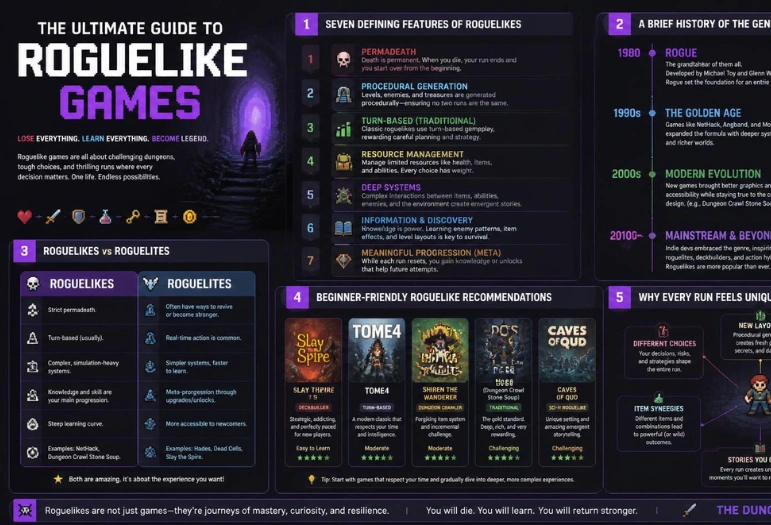
Direct answer: A roguelike is a run-based role-playing game built around permanent death, procedural generation, and meaningful decisions under uncertainty. In the traditional form, play is usually turn-based and grid-based. Death ends the character’s run, so lasting progress comes mainly from what you learn rather than permanent stat upgrades.
That definition gets messy because modern games borrow some of those mechanics while dropping others. Action games such as Hades are often grouped under the same broad umbrella, although “roguelite” is usually the more precise term when permanent upgrades carry between attempts.
| Key point | What it means |
| Namesake | Rogue, released in 1980 |
| Level design | Maps, enemies, or items change between runs. |
| Death | A failed run usually sends you back to the beginning. |
| Traditional combat | Turn-based and commonly grid-based |
| Main skill | Learning systems, risks, enemies, and resources |
| Modern variation | Roguelites often add persistent progression. |
Rogue was created by Michael Toy, Glenn Wichman, and Ken Arnold for Unix. Its random dungeons and ASCII presentation helped establish the design tradition that followed.
Why Every Run Feels Different
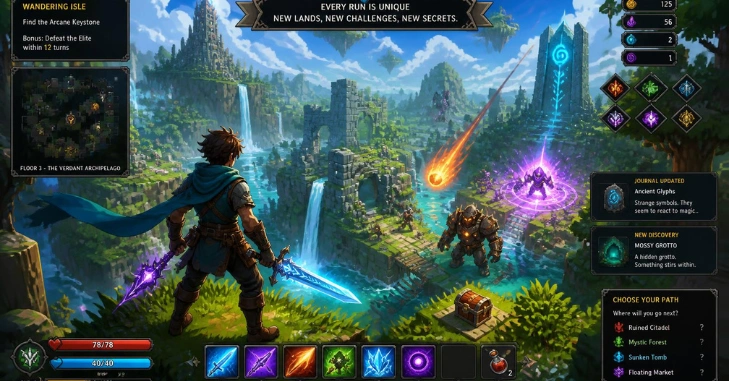
Procedural generation is one reason these games stay replayable. A new attempt may rearrange rooms, enemies, treasure, or item locations. You can learn the rules, but you can’t memorize every future run. Permadeath gives those changes weight. A risky doorway matters more when a mistake can erase an hour of progress. You start making decisions around survival rather than rushing toward the next objective.
Traditional design also gives you time to think. The Berlin Interpretation describes turn-based play as a system in which each command represents a single action. The game waits while you choose your move. Grid-based positioning adds another tactical layer.
Several mechanics tend to work together:
- Procedural generation changes the situation from one attempt to another.
- Permadeath makes failure costly and forces a fresh run.
- Resource management makes health, food, equipment, and other supplies meaningful.
- Exploration rewards learning unfamiliar spaces and systems.
- Tactical choices matter because careless moves can have permanent consequences.
The result is a form of progression that happens partly in the player’s head. You learn which fights to avoid, which resources to save, and which risks are worth taking.
What Makes a Roguelike Different From a Roguelite?
The easiest practical distinction is what happens after you die. A traditional game resets most of the character’s progress. A roguelite often gives you something permanent to carry into the next attempt.
| Feature | Traditional form | Roguelite |
| Run failure | Major reset | Major reset, often with retained upgrades |
| Permanent power growth | Usually limited or absent | Common |
| Combat style | Often turn-based | Frequently real-time |
| Movement | Commonly grid-based | Any movement system |
| Main long-term gain | Player knowledge | Knowledge plus unlocks or upgrades |
| Familiar examples | NetHack, Angband, Dungeon Crawl Stone Soup | Hades, Dead Cells, Slay the Spire |
This division is useful, but it isn’t an official law. Current explanations across gaming sites use the two labels with different levels of strictness. The broader public meaning often focuses on procedural runs and death, while traditional players use a narrower definition. That is why two people can describe the same game differently without either misunderstanding its mechanics. You might also like MMO Meaning.
The Berlin Interpretation Is a Guide, Not a Gate
In 2008, developers and players at the International Roguelike Development Conference produced the Berlin Interpretation. It lists high-value traits such as random environments, permadeath, turn-based actions, grids, resource management, complexity, and exploration.
Its wording includes an important qualification. Missing a few factors does not automatically put a game outside the genre. Having a few factors does not automatically put it inside either. The goal was to describe how closely a title adheres to a recognized design tradition, not to restrict developers.
That nuance matters today. A game can borrow random levels and permanent death while playing, nothing like Rogue. The mechanics tell you more than the store tag.
Where the Genre Came From
Rogue appeared in 1980 and was built for Unix terminals. Its dungeon appeared through text characters rather than modern graphics. Levels were randomly generated, so players could not solve the game by memorizing a single map.
Later titles expanded those ideas. Hack, NetHack, Moria, Angband, ADOM, and Dungeon Crawl Stone Soup introduced deeper item systems, enemies, character systems, and tactical choices. Several became reference points for the Berlin Interpretation.
Graphics changed dramatically over the following decades, moving from terminal characters to upscaling and frame generation, as described in Techixia’s DLSS 5 coverage. The central appeal did not. You enter an uncertain situation, make decisions with limited information, fail, learn, and try again.
A Four-Question Test for Any Game
Instead of arguing over labels, ask four practical questions.
- Does death end the current run? If failure reloads a nearby checkpoint, the design is already moving away from the traditional model.
- Does each attempt meaningfully change? Random rooms, enemy placement, items, or encounters should force you to adapt.
- How tactical is each decision? Turn-based movement and grid positioning point toward the older design tradition.
- What survives after death? Knowledge favors the traditional model. Permanent weapons, stats, currencies, or abilities point toward a roguelite structure.
This test is more useful than checking for one mechanic. Procedural generation alone does not define the genre, and neither does permanent death.
Good Starting Points for Beginners
Your first game should match the type of challenge you enjoy.
| Game | Style | Good fit if you want |
| Dungeon Crawl Stone Soup | Traditional, turn-based dungeon crawler | Classic tactical decision-making |
| NetHack | Deep traditional dungeon crawler | Complex systems and experimentation |
| Hades | Fast action roguelite | Combat, story, and permanent progression |
| Slay the Spire | Deck-building roguelite | Strategy without real-time action |
If you want to understand the older design philosophy, start with Dungeon Crawl Stone Soup. If you prefer fast combat and a gentler long-term progression curve, Hades makes the contrast easy to see.
PC players may also want to keep the hardware side separate from genre terminology. Techixia’s home Wi-Fi router guide includes a gaming-focused option for players who share a connection. If your machine refuses to boot before a session, the site’s solutions for a computer that will not turn on cover the usual causes and repairs.
The Simple Way to Think About the Genre
Don’t judge a game by permanent death alone. Look at what changes between runs, what survives after failure, and how much the design rewards tactical knowledge. For the clearest comparison, play one traditional turn-based title and one modern roguelite. An hour with each makes the difference easier to understand than any argument over terminology.
Conclusion
Roguelike games are built around a simple but powerful idea: every run is a new challenge, and failure is part of learning. Procedural generation keeps environments unpredictable, while permadeath gives each decision greater weight. In traditional roguelikes, turn-based movement, grid-based exploration, resource management, and tactical planning make even a single move important.
Modern roguelites have expanded the formula by adding real-time combat, story progression, unlocks, and permanent upgrades. That means you can enjoy the same run-based excitement without following every rule of the traditional genre.
Frequently Asked Questions
The name refers to games that follow the design tradition established by Rogue. The classic form emphasizes random environments, permanent character death, tactical turns, grid movement, resource management, and exploration. Modern use of the label is broader, so checking the game’s specific mechanics gives you a clearer answer.
In the traditional form, death ends that character and sends you back to the start. Run-specific equipment and progress disappear. What survives is your knowledge of enemies, items, tactics, and systems. A roguelite may also preserve currencies, abilities, story progress, or other permanent upgrades.
No. Its original text says missing some factors does not automatically exclude a game. The document works better as a way to assess how closely a title adheres to the classic design tradition.
It belongs to the same broad family of run-based games, but “roguelite” more precisely describes its design. Death resets the run while permanent progression, upgrades, relationships, and story development continue. That persistent growth separates it from stricter traditional designs.
A reset turns knowledge into progress. You recognize dangerous enemies sooner, allocate resources more effectively, and understand which risks pay off. Random generation keeps that knowledge useful without making every attempt identical.