

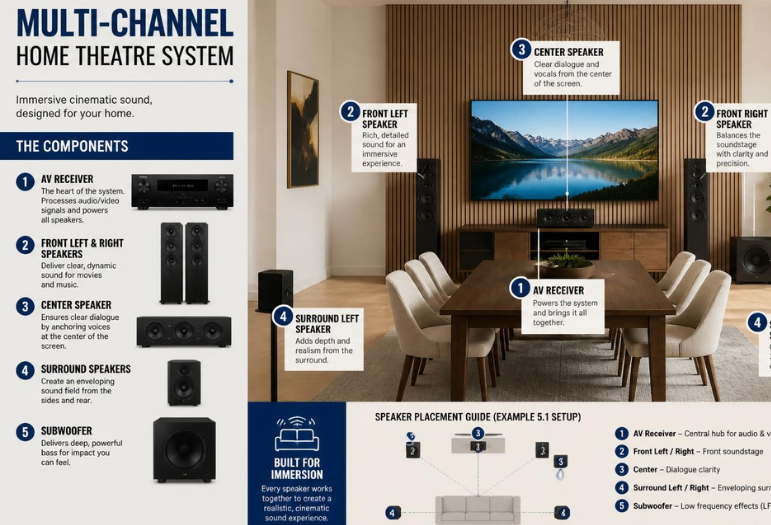
A multi-channel home theater uses several speakers around your viewing position to reproduce dialogue, music, bass, and effects from different directions. Most U.S. homes should start with 5.1 surround sound. Larger rooms can benefit from 7.1, while 5.1.2 or 7.1.4 systems add height channels for Dolby Atmos.
The biggest improvement doesn’t always come from adding more speakers. Matching the speaker layout to your room, using a capable AV receiver, and calibrating the system correctly can make a bigger difference.
| Home theater setup | What it includes | Best suited for |
| 2.1 | 2 speakers + 1 subwoofer | Music, small rooms, simple TV audio |
| 3.1 | Left, center, right, and subwoofer | Clear dialogue without rear speakers |
| 5.1 | 5 speakers + 1 subwoofer | Most living rooms and first surround systems |
| 7.1 | 7 speakers + 1 subwoofer | Larger rooms with space behind seating |
| 5.1.2 | 5 ear-level + subwoofer + 2 height channels | Entry-level Dolby Atmos |
| 5.1.4 | 5 ear-level + subwoofer + 4 height channels | Stronger overhead effects |
| 7.1.4 | 7 ear-level + subwoofer + 4 height channels | Dedicated or larger theater rooms |
Dolby explains that the first number identifies conventional ear-level speakers, the second represents the subwoofer or low-frequency channel, and the third identifies overhead or height speakers in an Atmos layout.
What Is a Multi-Channel Home Theatre?
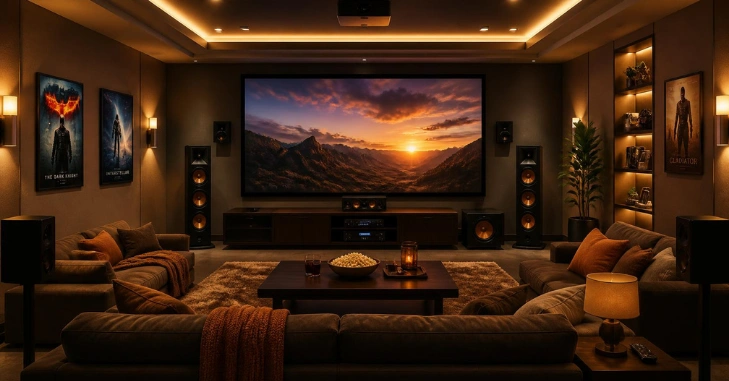
A multi-channel system separates a soundtrack into distinct speaker positions rather than reproducing everything from a single television speaker or a stereo pair. The front-left and front-right speakers create much of the main soundstage. A center speaker usually handles dialogue and other screen-focused sounds. Surround speakers reproduce effects beside or behind you, while the subwoofer handles low-frequency effects.
Multi-channel home theater This separation is why a properly arranged surround system can make direction easier to hear. A car can move across the screen while its sound moves with it. Background noise can sit behind the viewer rather than being squeezed into the front soundstage. Dolby Atmos extends this idea vertically. Height or overhead speakers let compatible soundtracks position effects both above and around the listening area.
“Theatre” vs. “theater” in the United States
The search phrase uses “theatre,” but home theater is the more common U.S. spelling. Both refer to the same type of entertainment system. For a U.S.-focused setup, you’ll usually see manufacturers and retailers use terms such as “home theater receiver,” “surround sound,” “5.1-channel system,” and “Dolby Atmos.”
How the Main Speaker Channels Work
Knowing what each speaker does makes it easier to decide where your money and space should go.
Front left and right.
These speakers reproduce music, effects, and sounds that move across the front of the room. They also create stereo imaging when you listen to two-channel music.
Place them on opposite sides of the television or projection screen. Aim them toward the main listening position where appropriate.
Center channel
The center speaker anchors dialogue and other sounds to the screen. Dolby recommends positioning it directly above or below the display so voices seem to come from the picture.
A capable center speaker can be particularly useful in movies with busy soundtracks because it gives dialogue its own physical channel.
Surround speakers
Surround speakers reproduce side and rear information. In a 5.1 layout, you have one surround speaker on each side of the listening area. A 7.1 system adds two rear channels. That extra pair makes more sense when there is enough room behind the seating for useful separation.
Subwoofer
A powered subwoofer reproduces deep bass and the low-frequency effects channel found in movie soundtracks. Bass is less directional than higher frequencies, so placement is more flexible than it is for the front speakers. Dolby recommends experimenting with subwoofer location because room dimensions affect how bass behaves.
High speakers
Atmos systems add overhead or upward-firing speakers. A 5.1.2 arrangement has two height channels, while 5.1.4 has four. Dolby says overhead speakers can be ceiling-mounted, while Atmos-enabled models can direct sound upward so it reflects from the ceiling.
5.1 vs. 7.1 vs. Dolby Atmos: Which Should You Choose?
For most buyers, 5.1 is the sensible starting point. It provides genuine surround sound without requiring a large room, complicated wiring, or a high-channel-count receiver. Choose 7.1 when your room has enough depth to position rear speakers behind the main seats. Adding rear channels in a cramped room can provide less benefit than improving your existing five speakers.
Choose 5.1.2 for an accessible entry point to Dolby Atmos. You retain the familiar 5.1 arrangement while adding two height channels. A 5.1.4 or 7.1.4 configuration makes more sense when immersive audio is a priority, and the room can support four height positions. Dolby publishes dedicated setup diagrams for both 5.1.2 and 7.1.4 systems.
What Equipment Do You Need?
A conventional multi-speaker system requires more than just a collection of speakers. Check the entire signal path before buying individual components.
You’ll typically need the following.
- A TV or projector
- An AV receiver with enough powered channels
- Front-left and front-right speakers
- A center speaker
- Surround speakers
- A powered subwoofer
- Height speakers for an Atmos configuration
- Speaker wire
- Suitable HDMI cables
- Playback sources such as a game console, streaming box, or disc player
The receiver deserves particular attention. A seven-channel receiver may run 7.1 or 5.1.2, but it generally cannot power a full 7.1.4 arrangement by itself. That configuration requires more processing and amplification channels.
Receiver specifications also determine which surround formats, HDMI features, resolutions, and refresh rates your system can pass.
If you’re also choosing or positioning the display, Techixia’s guide to mounting a TV safely on the wall covers mounting, cable management, and power considerations.
How to Set Up a Multi-Channel Home Theater
Start with the listening position rather than placing speakers wherever furniture leaves a space. Dolby’s current guides recommend choosing a central seating point and aiming the main speakers toward that position.
1. Position the screen and main seat. Decide where you will normally watch before fixing speaker locations.
2. Place the front speakers. Place the left and right speakers on either side of the display, and the center speaker close to the screen.
3. Add the surrounds. Position the surround pair beside or slightly behind the listener, depending on your chosen layout.
4. Position rear speakers if using 7.1. Keep enough separation behind the seating for the rear channels to create a distinct sound field.
5. Add height channels for Atmos. Follow the placement guide for your exact 5.1.2, 5.1.4, or 7.1.4 configuration instead of guessing.
6. Connect each speaker to the correct receiver output. Keep polarity consistent and label cables if several runs disappear behind furniture or walls.
7. Run receiver calibration. Many modern AV receivers include a calibration microphone that measures speaker distance, level, and room response.
8. Test real content. Check the dialogue, surround movement, bass, and Atmos material before deciding that a speaker needs to be moved or replaced.
A neat installation also makes troubleshooting easier. Techixia’s home-office setup guide includes useful ideas for organizing equipment and cables in multipurpose rooms.
Don’t Overlook HDMI, Streaming, and Network Connections
Your speakers can only reproduce the audio that reaches the receiver. If the TV is sending sound back to an AV receiver, check which HDMI ports and audio-return features both devices support. Likewise, verify the capabilities of consoles, streaming devices, and other sources before assuming an Atmos label guarantees Atmos playback in every configuration.
Streaming also depends on a stable connection. A wired Ethernet connection can be useful for stationary entertainment hardware, while strong Wi-Fi may be enough for most streaming devices.
Homes with poor wireless coverage can use Techixia’s home Wi-Fi router guide to compare single-router and mesh approaches.
Common Setup Mistakes to Avoid
Buying the largest channel count you can afford is one of the easiest mistakes to make. A well-positioned 5.1 setup can outperform a crowded system with extra speakers placed wherever they happen to fit. Another mistake is treating calibration as optional. Level differences, speaker distances, crossover settings, and room acoustics can change what you hear on the couch.
Avoid placing every speaker at the front of the room. That may produce louder audio, but it removes much of the directional separation that makes surround sound useful. Don’t assume the subwoofer must sit beside the television either. Try more than one practical position and listen for smoother bass at the main seat.
Finally, check equipment compatibility before purchasing. The receiver needs enough channels and the right audio formats for the layout you intend to build.
Is a Multi-Channel System Better Than a Soundbar?
It depends on your priorities. A soundbar is easier to install, requires fewer cables, and takes up less space. Some current models also use separate subwoofers, wireless surrounds, and height drivers. A component speaker system gives you more control over speaker location, amplification, upgrades, and replacement. You can change one part without replacing the entire system.
For renters, apartments, and smaller rooms, the simplicity of a soundbar can outweigh the benefits of separate speakers. A dedicated room or larger living area gives a traditional surround system more room to show its strengths.
If you use the system for gaming too, Techixia’s game controller guide can help you refine the rest of a console or PC entertainment setup.
How Much Should You Spend?
There isn’t a fixed price that produces good surround sound. Room size, speaker count, receiver features, and whether you already own a display all change the budget. A useful approach is to prioritize the core 5.1 system first. Buy a receiver that leaves room for the expansion you genuinely expect to make.
For example, someone planning to add two Atmos channels later may benefit from buying a suitable seven-channel receiver now. There is little reason to pay for 11 amplified channels when the room will never contain that many speakers. Put money into placement, setup, and compatible components before chasing a higher number printed on the receiver box.
Build for Your Room, Not for the Biggest Number
The right surround setup is the one your room can support well. For many U.S. homes, that means starting with a good 5.1 system, placing each speaker correctly, and calibrating the receiver.
Move to 7.1 when you have usable space behind the seats. Add Atmos when you can position height channels correctly, and your receiver supports the final configuration. Planning around the room first keeps the system easier to install, easier to upgrade, and far more likely to sound the way you expected.
Conclusion
Building a multi-channel home theater is not simply about buying the receiver with the most channels or adding as many speakers as possible. The best results come from choosing a layout that matches your room, placing each speaker correctly, using compatible equipment, and taking time to calibrate the system.
For many households, a 5.1 home theater system is an excellent starting point. It provides front-left, center, front-right, and surround channels along with a subwoofer without requiring a large dedicated room. If you have sufficient space behind the seating, a 7.1 setup can add rear-channel separation. For a more immersive experience, configurations such as 5.1.2, 5.1.4, and 7.1.4 introduce height channels for compatible Dolby Atmos content.
Frequently Asked Questions
It is a home audio system that uses separate speaker channels around the listener. Common layouts include 5.1 and 7.1 surround sound, while Dolby Atmos configurations add height channels such as 5.1.2 or 7.1. 4.
7.1 offers two additional rear channels, but it works best when the room provides enough space behind the seating. In many living rooms, a well-positioned 5.1 setup is the more practical choice.
It means five conventional ear-level speakers, one low-frequency (subwoofer) channel, and two height channels. Dolby uses the same x.y.z naming structure for layouts such as 5.1.4 and 7.1. 4.
For a traditional passive-speaker setup, usually yes. The receiver handles source switching, surround processing, amplification, and speaker configuration. Powered or wireless systems may package these functions differently.
You can, though matching the front-left, center, and front-right speakers helps maintain a consistent tonal character across the front soundstage. Subwoofers don’t need to come from the same product family.
You can, though matching the front-left, center, and front-right speakers helps maintain a consistent tonal character across the front soundstage. Subwoofers don’t need to come from the same product family.