

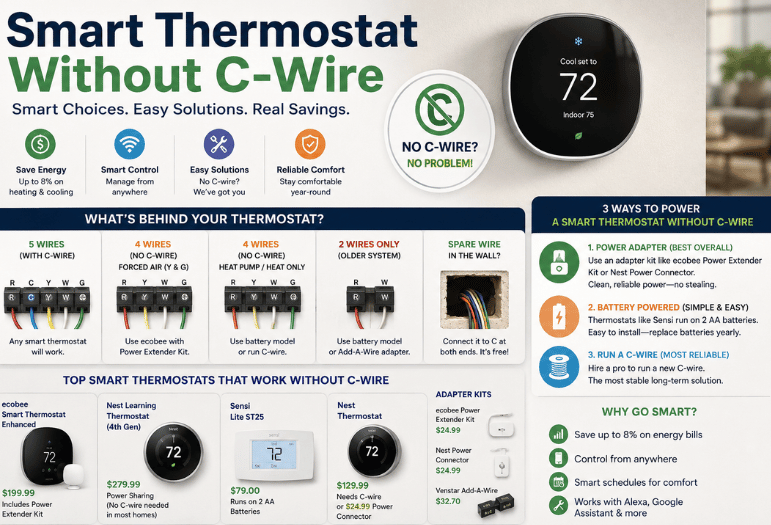
Pull your old thermostat off the wall, and you may find four wires where the new box wanted five. That missing fifth one is the C wire, and it stalls more Saturday upgrades than any other surprise. You can still run a smart thermostat without C-wire power by three separate routes. Which one fits depends on your wall plate, not on the brand you like.
Here is the short version. Buy a model that ships with a power adapter, buy one that runs on batteries, or pay to add the wire itself. ecobee includes its Power Extender Kit with most models, Google sells a $24.99 Nest Power Connector, and Sensi runs on two AA batteries. Every one of those choices costs you something.
| What is behind your wall plate? | Best move | What it costs |
| Five wires, one landed on C. | Any model works, so choose the one with the most features. | $79 to $280 |
| Four wires, no C, forced air with Y and G | ecobee with its bundled Power Extender Kit | $0 extra on most Ecobee models |
| Four wires, no C, heat pump, or heat only | Battery model, or have C pulled | $79, or $100 to $200 of labor |
| Two wires only, older boiler | Battery model, or an add-a-wire adapter | $32.70, Venstar Add-A-Wire |
| A spare wire stuffed into the wall | Land it on C at both ends | Free |
Key Takeaways
- The C wire carries no heating or cooling signal. It keeps power flowing to the wall unit.
- Three things hide behind “no C wire needed”: power stealing, a bundled adapter, and batteries.
- Google’s pricing is counterintuitive. Its $129.99 Nest Thermostat often needs a C wire, while the $279.99 Learning Thermostat usually does not.
- Adapter kits are cheap. The Ecobee Power Extender Kit and the Nest Power Connector both list at $24.99.
- Power stealing causes the most callbacks, especially on newer furnace control boards.
What the C Wire Actually Does
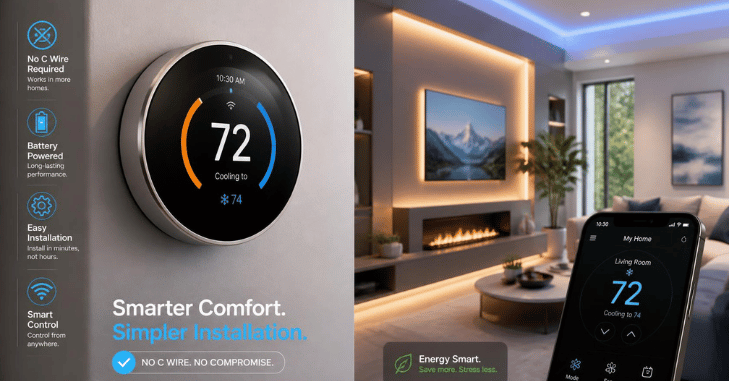
Your furnace has a small transformer putting out 24 volts. That power reaches the thermostat on the R wire. W, Y, and G are switches: close one and the furnace fires, the compressor starts, or the blower spins. The C wire, short for common, completes the circuit so current flows continuously instead of only when something runs.
Smart Thermostat Without C-Wire: An old mercury thermostat never needed that. It was a switch on a wall, nothing more. A connected model keeps a Wi-Fi radio, a display, and a processor awake around the clock. According to ENERGY STAR, the US Environmental Protection Agency program that certifies them, a certified model may draw up to 3.0 watts on average in network standby. To carry the label, it must also cut annual heating runtime by at least 8%. That constant appetite is why the common wire matters now.
Weak Wi-Fi at the wall causes a separate headache people blame on wiring. If the hallway is a dead spot, our walkthrough on how to improve your home Wi-Fi signal is the cheaper first move.
The Two-Minute Check at Your Wall Plate
Do this before you buy anything.
- Switch off the furnace breaker. Shorting two terminals can blow a fuse.
- Pull the thermostat face off its base. Most snaps or slides are free.
- Photograph the terminal block before you touch a screw.
- Find the terminal marked C, sometimes printed as Com or B. A label alone proves nothing.
- Check whether a wire is screwed into it. An empty C terminal is the whole problem.
- Peer into the drywall hole, then open the furnace panel and check the same cable there. Installers often push a spare conductor back into the cavity, and it only helps if both ends are free.
Find that unused conductor, and you are done. Land it on C at the thermostat and at the furnace board, and you have a five-wire setup for nothing.
How a Smart Thermostat Without a C- Wire Gets Its Power
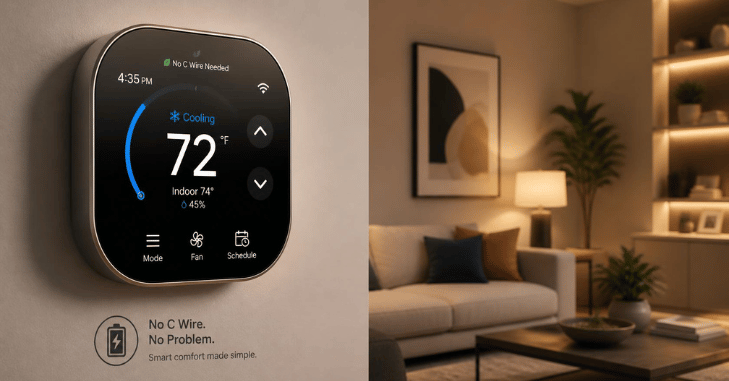
Power stealing pulls a trickle of current through the heating or cooling wire while the system idles, then stores it in a small internal battery. Nothing extra gets installed. Google calls its version Power Sharing, and it is why the Nest Learning Thermostat works in most four-wire homes.
An included adapter works differently. The Ecobee Power Extender Kit mounts on the furnace and merges the fan and compressor signals onto one conductor, freeing the spare wire to serve as C. Nothing gets stolen, and the thermostat draws clean power.
Batteries are the simplest answer of all. Sensi Lite and the standard Sensi model run on two AA cells and skip the power question. Trouble lands about a year later, when the cells fade, the Wi-Fi radio drops off, and the app goes quiet. Your heat keeps running at the last setting, so the failure is easy to miss. Weak coverage makes it worse, which is why a mesh Wi-Fi system for dead zones can matter as much as the thermostat itself.
Models Compared on Price and Power
| Model | US price | How it runs without C | Watch out for |
| Nest Learning Thermostat, 4th Gen | $279.99 | Power Sharing: no C wire in most homes | Highest price here |
| Nest Thermostat | $129.99 | Needs C, or the $24.99 Power Connector | Heat pump and heat-only systems |
| ecobee Smart Thermostat Premium | $259.99 | Power Extender Kit in the box | Kit needs both Y and G present. |
| ecobee Smart Thermostat Enhanced | $199.99 | Power Extender Kit in the box | Same wiring requirement |
| ecobee Smart Thermostat Essential | $139.99 | Kit sold separately at $24.99 | Not bundled, unlike its siblings |
| Sensi ST55 | $99.00 | Two AA batteries | Battery changes roughly yearly. |
| Sensi Lite ST25 | $79.00 | Two AA batteries | C is still required on heat pumps. |
Our Pick for Most Forced-Air Homes: Ecobee Enhanced
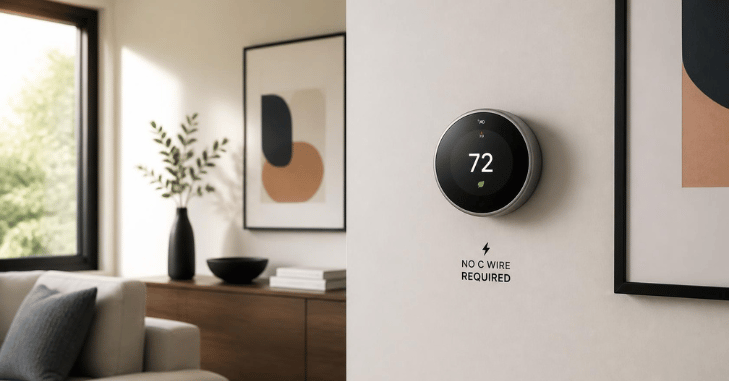
At $199.99, it arrives with the Power Extender Kit in the box, so the wiring problem is solved before you open the app. Pros: continuous power, no stealing, sensor support later. Cons: the kit needs a Y and a G wire, so a heat-only boiler is out.
Best cheap escape: Sensi Lite at $79
Two AA cells and a screwdriver. Pros: the lowest price here, and no furnace work. Cons: Copeland still requires C on heat pump and cool-only systems, and you own a battery schedule forever.
The counterintuitive one
Buyers assume the cheaper Nest is the easier install. Google’s compatibility guidance says the opposite. The $129.99 Nest Thermostat calls for a C-wire or a power connector on heat-only, cool-only, zoned, and heat-pump systems. The $279.99 learning thermostat runs on power sharing in most homes.
Where Power Stealing Goes Wrong
Borrowing current through a control wire works right up until it does not. Older relay-based furnaces tolerate it well. Newer boards do not always agree. The symptoms are recognizable once you know them—a relay chatters. Blowers kick on for thirty seconds with no call for heat. The system short-cycles, or the 3-amp fuse on the board pops, and the display goes dark. High-efficiency boards read those inputs electronically, so a trickle they never expected can register as a real call.
None of that makes the no-C- Wire route a bad idea. It makes it the weakest of the three methods. If your equipment went in during the last decade, favor the adapter or the batteries.
Adapter Kits and What They Cost
- Ecobee Power Extender Kit, $24.99. Mounts magnetically inside the furnace cabinet and frees one wire for C. E. Co-ee models only.
- Nest Power Connector, $24.99. For the Nest Thermostat, Thermostat E, and 3rd-gen Learning Thermostat. No new cable, no drilling.
- Venstar Add-A-Wire, $32.70. Brand agnostic. Turns four wires into five and ships with a diode and wire nuts.
- Plug-in 24-volt transformer, roughly $15 to $25. Cheap, but you get a visible cord.
All of this is 24-volt control wiring, not the 120 volts feeding a receptacle. Different rules apply on the line voltage side, which our outdoor smart plug buying guide covers.
When Running a New C Wire Is the Better Buy
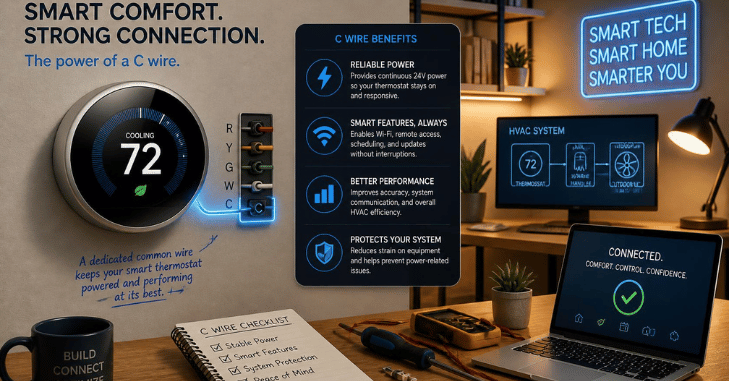
Sometimes the wire is worth paying for. An HVAC technician typically charges $100 to $200 to pull a new thermostat cable, and the job takes one to two hours while the attic or basement is open. Say yes when the run is short and open. A technician already booked for a tune-up makes it cheaper still, and models like the Sensi Touch 2 flatly require C. Skip it when the cable is buried in a finished two-story wall. There, $24.99 of adapter beats $200 of drywall repair.
The Verdict and What to Do Next
For most American homes with forced-air heat, the ecobee Enhanced at $199.99 is the cleanest answer, because the fix ships in the same box. Choose the Sensi Lite at $79.00 if you want the cheapest working solution and can live with batteries. Pick the Nest Learning Thermostat at $279.99 for automation and power sharing instead of hardware on the furnace. Smart Thermostats Without C-Wire savings are real but modest. ENERGY STAR reports that a certified model saves the average home about 8% of its heating and cooling bill, near $50 a year. There is more on this in Power Strip.
Your next step takes ten minutes. Kill the breaker, photograph your terminal block, and run that photo through the manufacturer’s compatibility checker before you order. Then check your utility’s rebate page, since many programs knock $50 to $100 off the price. Sort the network side too, because a thermostat is only as reliable as the signal reaching it, and our home Wi-Fi router recommendations are a sensible starting point.
Frequently Asked Questions
An adapter kit or batteries are safe, since neither pulls current through a control wire. Power stealing is the one to think twice about on a modern board, where it can cause chattering relays, short cycling, or a blown fuse.
Only if you give up manual fan control, and only where the fan runs automatically with heat and cooling. Rewiring G to C at both ends works, but an adapter kit does the same job without the compromise.
Sensi and Sensi Lite run on AA batteries. ecobee Premium and Enhanced include the Power Extender Kit. Nest Learning uses power sharing. Copeland’s Sensi Touch 2 and Google’s cheaper Nest Thermostat both need the wire or an adapter.
Plan on a fresh pair of AA cells about once a year, sooner if you poke at the screen a lot. Swap them on a schedule instead of waiting for a warning. Your heating or cooling keeps running at the last setting if you forget, so nothing dramatic happens.
No. Without power, the furnace transformer is dead, so the low-voltage side has nothing either. Battery models keep their display and schedule but cannot start equipment with no electricity.